
quinta-feira, dezembro 03, 2009


quarta-feira, dezembro 02, 2009
Students beaten and brutally evicted in Frankfurt
This afternoon the president of the Goethe University of Frankfurt/M threatened the occupiers of the "Casino" [a building on campus] that he will exercise property rights, if they don't leave the building within 10 minutes. Most students were not intimidated and decided to stay. One professor also stayed and defended the students' position.
Soon after [6.10pm CET] special police forces stormed the place.
 The students, together with the professor, barricaded themself inside the "ballroom" and were beginning their scheduled alternative seminar titled "What does emancipatory education mean?". Soon after the police managed to break through and entered the place. The windows were covered [to prevent the media from taking footages of the eviction] and everyone inside was encircled by the police. The robocops asked the media to leave the room - those who didn't follow instructions immediately were pressured to do so.
 Students linked arms with each other, but didn't actively resist. So they were carried outside - all 130 of them. Hundreds gathered outside the building [but still on campus] and protested in support and against repression. Soon they were attacked by police forces as well - mostly with batons. Various students were injured and had to be transfered to the hospital. One girl had two fingers broken. Some were chased through the city.
In the end 300 students were ID'd [incl. photographed and fingerprints taken]. Hundreds received bans from campus or even the city by the police. Many are expected to be tried and are charged with "breach of domestic peace" [among others]. At least 2 students were taken into custody.
Soon after the eviction many gathered inside the "autonomous space" on campus called "Koz" to discuss on how to continue. People are angry and will not give up so easily.
As a direct reaction to these incidents about 50 students spontaneously decided to protest through the inner city of Marburg [Germany] to inform the public about the violence.
Further acts in Solidarity of the students in Frankfurt/M and against repression & police violence are most welcome.
Soon after [6.10pm CET] special police forces stormed the place.
In the end 300 students were ID'd [incl. photographed and fingerprints taken]. Hundreds received bans from campus or even the city by the police. Many are expected to be tried and are charged with "breach of domestic peace" [among others]. At least 2 students were taken into custody.
Soon after the eviction many gathered inside the "autonomous space" on campus called "Koz" to discuss on how to continue. People are angry and will not give up so easily.
As a direct reaction to these incidents about 50 students spontaneously decided to protest through the inner city of Marburg [Germany] to inform the public about the violence.
Further acts in Solidarity of the students in Frankfurt/M and against repression & police violence are most welcome.
terça-feira, dezembro 01, 2009
Students protests in Serbia are on a high tide
Wave of student struggle is sweeping over the streets of Serbian capital, Belgrade. Three marches of some 1,500 students held on Monday, Wednesday and Friday have marked a new phase in student organising. These protests were the most massive and political ones in the past 10 years. It was also the first time for us to block two main bridges that connect two halves of city – we blocked Branko’s bridge on Wednesday and Friday and Gazela on Friday, after protesting in front of an international conference on Bologna reforms. Our last two protests also had one important person in the front row – Joe the dredger, who is a symbol of the 5th of October 2000 revolution, when we toppled the hated president Milosevic.
The six demands we’ve had by now all deal with specific problems that came out of neoliberal and bologna reforms of education. Protests were started by the official student representatives, led by the president of the Student parliament of University in Belgrade, who is also a member of the ruling party. Never the less, our student group Another University is Possible, that stands against the bologna reforms and for free education for all, made some crucial interventions in coalition with other student representatives who want to see this protest win – pushing towards generalising our demands and connecting with our collegues internationally, as well as with workers. We’ve printed hundreds of bulletins, together with a letter of support from Austria, which was then repeatedly cited in the biggest Serbian daily.
Yesterday, we were supposed to have another meeting with the government, but instead the president of the Student parliament got a statement in which the government ‘promisses’ to fulfill five out of six demands, without saying when or how they will do that. As most of us expected, he decided to end the protest and called his collegues to go back home. The rest of us realized that we were scammed, so we immediately organised a plenum of a few hundred students where we decided to demand that those representatives who failed us step down, but also to radicalise our demands and tactics – we are now talking about organising democratically, occupying our Universities and demanding free education for all.
We already won the support of three trade unions, one inter-striking cometee and union of taxi and truck drivers. Next Monday we will be protesting with the support of some 200-300 taxi veachles, and on Tuesday we should be accompanied by other workers who supported us.
This is presenting a huge problem for our government who only just managed to get a huge loan from Russia and prevent the worker struggls from exploding. This is why any kind of international support is crucial to us at the moment. We must connect our struggle with the current struggles worldwide. The next week will be crucial.
One world – one struggle!
Call for International Day of Action: 5th December
Worldwide action – Mass Rally in Vienna
Nevertheless media and politics still do not regard the importance of this international movement. That's why we want to put things right!
Next Saturday, the 5th of December 2009 will be the next International Day of Action. In Vienna we are planning a mass rally with participants from the whole country. In the other Universities of Austria we will draw attention once again with smaller creative activities!
This call goes out to all of us! Students, Pupils, Teachers, Researchers! United we are strong! Education is not for sale!
Everyone can participate in this global campaign! Public discussions, demonstrations, street theatre, protest songs, strikes, squats of public buildings, info campaigns, letters to th editors, flash mobs, window flags, sit-ins, etc.
What do you think about a joint flash mob, doing the same thing, at the same time, in all countries?
We are looking forward to a strong international campaign!
segunda-feira, novembro 30, 2009
Universidades europeias têm falta de autonomia
As Universidades europeias têm falta de autonomia, segundo um estudo da Associação Europeia de Universidades (AEI) e que recolheu contributos de 34 conferências de reitores, incluindo de Portugal.O estudo, divulgado hoje, em Bruxelas, abrange os sistemas dos 27 Estados-membros da União Europeia (sendo que na Bélgica existem dois, o flamengo e o francófono), e ainda da Croácia, Islândia, Noruega, Sérvia, Suíça e Turquia. O documento foi dividido em quatro áreas de autonomia: organizacional, financeira, de recursos humanos e académica.
Segundo o estudo, é necessária uma maior autonomia nas Universidades europeias para estas poderem “enfrentar novas exigências”, nomeadamente a necessidade de “maior e melhor liderança e gestão” .
Outro desafio que se coloca às instituições, segundo a AEI, é a “necessidade de novos técnicos e peritos em diversas áreas”.
A autonomia financeira foi a que, segundo o estudo, se revelou mais problemática, uma vez que a maioria das conferências de reitores a considerou “um desafio actual ou fututo”.
Entre os problemas relatados, contam-se os “baixos níveis de financiamento público” e o curto-prazo dos contratos de financiamento “que torna o planeamento difícil”.
A relação com os ministros da tutela foi outro ponto sensível apontado, nomeadamente por manifesta “falta de visão a longo-prazo para o que se quer das Universidades”.
No que respeita à organização, o estudo avaliou itens como estruturas e corpos governativos, para concluir que Portugal se inclui no grupo de dez países em que as estruturas académicas e corpos dirigentes, como o reitor, obedecem a um enquadramento jurídico, enquanto na maior parte dos sistemas avaliados as instituições decidem por si mesmas. Neste campo, a academia portuguesa inclui o grupo das universidades menos autónomas.
A autonomia financeira define-se pela capacidade de angariar fundos, a forma como são captadas verbas – nomeadamente com cobrança de propinas – e a possibilidade de as instituições poderem acumular rendimentos. Portugal está no grupo que tem de devolver verbas estatais que não tenham sido utilizadas, tal como a Turquia, Chipre, Roménia, Letónia, Lituânia e Sérvia.
Ainda neste campo, se, por um lado, as Universidades portuguesas cobram propinas para gerar receitas, por outro estão impedidas de recorrer ao crédito bancário, tal como instituições de outros 11 países. Uma maioria de 22 sistemas permitem às instituições de ensino superior o recurso ao crédito bancário.
No que respeita aos recursos humanos, em 25 dos sistemas analisados (incluindo o português) os salários são estipulados pela universidade, mas na academia portuguesa há ainda funcionários públicos, situação que tem vindo a ser alterada. Na República Checa, Eslováquia e Islândia só trabalham nas Universidades funcionários públicos.
A autonomia académica é praticamente generalizada nos casos estudados, mas, na maior parte dos casos, quando as instituições organizam novos programas académicos têm que os submeter à aprovação das autoridades competentes, que os avaliam. Em Portugal, como na maior parte dos casos analisados, os critérios de admissão são estipulados pela Universidade. No entanto, o sistema de quotas regulado pelo Estado apenas vigora em mais sete países.
Em 14 países são as Universidades que estipulam o número de alunos a admitir em cada curso e noutros 12 o regime simplesmente não existe.
sábado, novembro 28, 2009
Supporting students in Croatia for free education
On Monday, April 20th 2009, the independent student initiative for the right to free education started a peaceful occupation of the Faculty of Humanities and Social Sciences in Zagreb, Croatia. The occupation lasted for 35 five days, until May 24th, when the students voted to suspend the occupation.
 The students who organized the occupation demand the right to free education for all and the elimination of all tuition fees, at all levels of higher education: undergraduate, graduate and postgraduate. During the occupation, everyone was free to enter and leave the Faculty building, but regular classes were not held. Instead, students organized an alternative educational program, which consisted of lectures, public discussions, workshops, movie screenings and other happenings. Everyone was free to attend these happenings, whether they were students or not.
Every evening, students held an open assembly (plenum or plenary session) in which all students and citizens were allowed to participate. (After the occupation ended, the plenary sessions were held once a week, except for six weeks during Summer break). At the plenary sessions they discussed the situation and decided whether they would continue with the occupation the next day. Everyone was free to attend the plenum, to participate in discussions and to vote, whether they were students or ordinary citizens. The issue of the right to free education is not one that concerns only the students, it is an issue of relevance for the future of the entire society, therefore every member of the society has the right to participate in decision making at the plenary sessions.
So far, we have received numerous letters of support from individuals and organizations, both at home and from abroad. Among those who have expressed support for our cause are Noam Chomsky, Judith Butler and Slavoj Žižek. Full list of who supports us can be accessed here.
Sign the PETITION!!!
UPDATE: The students at the Faculty of Humanities and Social Sciences in Zagreb have started another peaceful occupation of their faculty on November 23rd.
sexta-feira, novembro 27, 2009
Estudiantes de la Federación Universitaria de Buenos Aires tomaron el Nacional Buenos Aires
El rectorado de la UBA suspendió la elección de representantes de profesores y graduados al Consejo Superior fijadas para mañana y reportó que el Colegio Nacional no dictará clases en lo que resta de la semana.
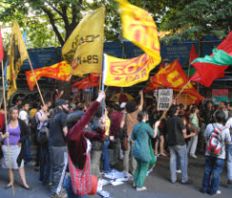 El rectorado que conduce Rubén Hallú informó en un comunicado que "las autoridades del Colegio Nacional de Buenos Aires se vieron obligadas a suspender las clases del turno noche en la jornada y de todos los turnos en el día de mañana", por la presencia de estudiantes que se oponen a la votación de los representantes que elegirán rector.
La universidad recordó que "el martes 17 de noviembre se realizó la Asamblea para elegir consejeros superiores del claustro de estudiantes, donde los representantes de la FUBA [Federación Universitaria de Buenos Aires] participaron sin inconvenientes" y donde obtuvieron la mayoría por ese sector al Consejo Superior.
La FUBA se opone a la realización de la Asamblea Universitaria fijada para el 14 de diciembre para elegir rector, tras la caducidad del mandato de Hallú, por considerar que los funcionarios "pretenden impedir la democratización del cogobierno universitario, adelantando ilegal e ilegítimamente la elección".
Mañana deberían tener lugar las asambleas de claustros para la elección de representantes de profesores y graduados en el Consejo Superior, pero se supendieron por la ocupación del Colegio.
Cristian Henkel, presidente de la FUBA, cuestionó que la renovación de consejeros del claustro de profesores que se iba a realizar mañana "es la antesala de una Asamblea Universitaria donde una minoría de 2000 profesores titulares concursados (el 0,5 por ciento de quienes integramos la universidad) tendrá el 52 por ciento de la representación".
Finalmente, sostuvo que ellos "determinarán el rumbo de la universidad a espaldas de 300 mil estudiantes, 40 mil profesores y 10 mil no docentes".
More info...Alunos invadiram Reitoria da Universidade de Buenos Aires no dia em que novo reitor da USP foi escolhido: na Argentina e em Lisboa, eleição é indireta, igual à USP; alunos só votam na Espanha.
terça-feira, novembro 24, 2009
Map of University occupations in Europe
Click here to better see the Map of University occupations in Europe
segunda-feira, novembro 23, 2009
The University of Hamburg is not happy with Dieter Lenzen because Trustees and AS “push-through procedure”
(Hamburg 20.11.2009) - Today, the Academic Senate (AS) from the University of Hamburg, confirmed Dieter Lenzen as president. Alone the short notice for the meeting in the heavily secured DESY Bahrenfeld speaks volumes – the whole process was not designed to be democratic or transparent and excluded a college audience completely. The university president should represent the entire university and be able to present him or herself publicly. Nothing like this was the case, although on Thursday more than 1,000 students called for public presentation. Many of the students and staff of the University and also the squatters of the Audimax lecture hall hold the confirmation of Lenzen as unjust – as they do the process and even the candidate Lenzen.
Lenzen himself in his speech to the AS patronizingly gave the impression: that considering he was “popularly” elected, he’ll take the job. This borders on extortion. Certainly we shall once again criticize the insidious tactics of the selection committee led by Albrecht Wagner. Firstly the deletion of certain candidates from the shortlist, before they could present themselves narrowed all margins and put those involved in the decision-making process under pressure. The logic behind this is: whoever rejects any of these candidates will only harm the university further (Eat or Die tactic). With this banal argument every candidate in this “electoral process” has been pushed through. To talk of voting is impossible because elections must always have something to do with choice and transparency. We would like to affirm at this point that we reject the decisions of the committee of the High school board at this time because of it’s lack of democratic legitimacy.
Continuar a ler o artigo...After confirmation some AS members came to the occupied Audimax, to read aloud the official press statement from the university – not a word mentioned the displeasure of many niversity members about procedures or the candidates – and questions were raised. One thing was clear, some of the AS members have had significant concerns about the procedure, which they have not expressed in public. We believe such an attitude to “voting” is fatal – because it is easy in retrospect, to criticize things, but does not allow them to be reversed immediately. The AS-member Prof. Schnapp argued that the hastily made decision dated back to the confusing conditions of the AS session held on Thursday at the Mineralogical Museum. This is a flimsy argument because had there been no protests on Thursday against the procedure and the candidates to be elected Lenzen would have been confirmed on that day. This statement distracts from the fact that procedures have been consciously disregarded, providing for a period of time between the election and confirmation of the Higher Education Council of the AS.
Some members of AS reported that Dieter Lenzen had convinced them of his candidacy, among other things, because he wanted to maintain democratic and transparent higher education regulations and structures at the university. (What does this mean?). In this and other controversial points, we doubt that all the members of AS have conscientiously informed themselves about the candidate Lenzen. A call to the AS-members of the Free University of Berlin would have been enough to learn that they must consistently threaten him with the involvement of the local administrative court to exercise their democratic rights. The current FU presidency at the local bureau in Berlin, acting under Dieter Lenzen is anything but “inclusive”. Rather Lenzen makes use of emergency-type test clauses frequently in the Berlin Higher Education – so that the academic self-government suffers as a result.
We will convert our anger at this decision into energy and ensure that Dieter Lenzen will not stay here long. It would be better if he chose not to accept the position. We also hope that he takes his leave from the students at the Free University Berlin, where he has also been adopted. No university needs Dieter Lenzen!
In Hamburg we are reviewing different strategies. One thing is certain: Lenzen is not our president, so we will speak of him in future only by the title “candidate Lenzen”.

domingo, novembro 22, 2009
Third day of fee protests at California Universities
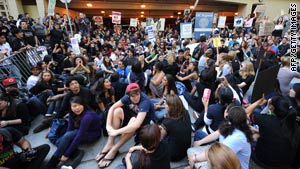 Demonstrators entered their third day of a building takeover at UC Santa Cruz on Saturday in protest of a tuition increase, an undertaking that a school spokesman called futile.
The occupation of Kerr Hall is just one of several demonstrations across University of California campuses this week after the regent's board approved a 32 percent increase in tuition Thursday.
University officials said the $505 million to be raised by the tuition increases is needed to prevent even deeper cuts than those already made due to California's persistent financial crisis.
Protesting students said the increase will hurt working and middle-class students who benefit from state-funded education.
On the Santa Cruz campus, where building occupations began last week with a library sit-in, about 100 students staged a sit-in in the second-floor lobby of Kerr Hall soon after hearing that the tuition increase had been approved, according to UC Santa Cruz Provost David Kliger.
The students made a list of 20 "demands" detailing how they want the administration to increase funding, spokesman Barry Shiller said. But the school has no plans to negotiate the demands with the student body, he said. The school just doesn't have the money, he added.
School officials hope the students realize that their demonstration is "not accomplishing anything" and is "just a disruption" to administrative duties on campus, he said.
The administration will continue to wait out the takeover, but Shiller said he is unsure of how long it will last. The school hopes the students will leave voluntarily, he said.
Read More...Are you there? Share your story, video...
Meanwhile, uprisings on other campuses have quieted since earlier mass demonstrations.
At UC Berkeley on Friday night, 41 protesters occupying a building were arrested. Authorities decided to cite them for trespassing and release them rather than take them to jail, per an agreement with student leaders, school spokeswoman Claire Holmes said. Three students were arrested there Friday morning.
Fifty-two students were arrested at UC Davis late Thursday after they refused to vacate the school's administration building.
And UCLA's Campbell Hall was occupied for several hours Thursday evening.
The angry students are condemning a nearly $2,000 tuition increase.
The first change, which takes effect in January, will raise undergraduate tuition to $8,373. The second increase kicks in next fall, raising tuition to $10,302, university spokeswoman Leslie Sepuka said.
Students who live on campus could pay an estimated $17,200 in additional fees that include the annual cost of books and housing, according to the system's July 2008 finance guide.
The January increase of about 15 percent is more than double the average public university tuition increase last year.
On average, tuition and fees at four-year public universities nationwide increased 6.5 percent, or to $7,020, since the previous school year, according to data from College Board.
Students eligible for financial aid and whose families make less than $70,000 will have their tuition covered, the university said.
SAVE the University [@ UC Berkeley]
SAVE the University is a UC Berkeley faculty group dedicated to preserving student access and academic quality at University of California.
- SAVE International Petition: SAVE the University invites academics and researchers affiliated with universities OUTSIDE THE UNITED STATES to sign the following petition in support of efforts to save the University of California as a great public university system
- Fight the Fee Hikes: sign the Petition to postpone the Regents Vote on Fee Increases
sábado, novembro 21, 2009
University of California, Santa Cruz: over 500 students are occupying the Kresge Town Hall
Click here to read more infos... Demands:
1. Repeal the 32% fee increase
2. Stop all current construction on campus
3. UC funds and budget are made transparent
4. Verbal and written commitment to Master Plan
5. Total amnesty to all people occupying buildings and involved in student protest concerning budget cuts including: Doug G., and Brian Glasscock and Olivia Egan Rudolph
6. Keep all resource centers open: engaging education, women's resource center, and all other diversity centers
7. Keep the campus child-care center open
8. Repeal cuts to the Community Studies Field Program
9. Re-funding the CMMU field studies coordinator positions
10. Get verbal and written agreement from admins to shut-down campus for one day for the purpose of educating students on the budget cuts
11. Said support for AB656
12. Said commitment to work-study for all who are eligible
13. Making UC Santa Cruz a safe campus for all undocumented (AB540) students and workers
14. Keeping LALS professors Guillermo Delgado & Susan Jonas
15. Repeal all furloughs to all campus employees, renege the 15% cut in labor time for custodians
16. Stop the gutting of funding for fellowships and TAships and the re-instatement of TAs who lost their jobs due the budget cuts from this quarter
17. Re-prioritizing funding so that essential student services i.e. the library get adequate funding to ensure regular library hours
18. Censure Mark Yudof
19. Un-arming UC police of all weapons including tasers
20. NO SCPD police allowed on campus
21. An apology from the regents and the state
22. Creating a free and permanent organizing space on campus for student activists and organizers (first options: Kresge Town Hall)
23. Due process for students:
a. trial by peers
b. constitutional rights for students tried under the UC judicial system
24. Making rent affordable for Family Student Housing, ensuring that the price does not exceed that of operating costs
Long Term:
1. no student fees
2. return to master plan
3. abolition of regents' positions
4. abolition of all student debts
5. tripling of funds from the state to public universities
6. all eligible students get work-study
7. highest UC salaries are tied proportionally to the lowest waged workers
8. Impeach Mark Yudof
9. Representation of students and faculty equal to UCOP/UC Regents
10. All UCSC tuition fees stay at UCSC
11. UC Money is only invested to education
a. cut ties with Lockheed Martin, Los Alamos & Livermore National Labs
signed,
The Occupants
Other strikes links:
Many protests of students across Germany
90,000 lecturers, pupils, students, parents and workers across Germany protested against the increasing commercialisation and privatisation of Education (as well as the implementation of the "Bologna Process").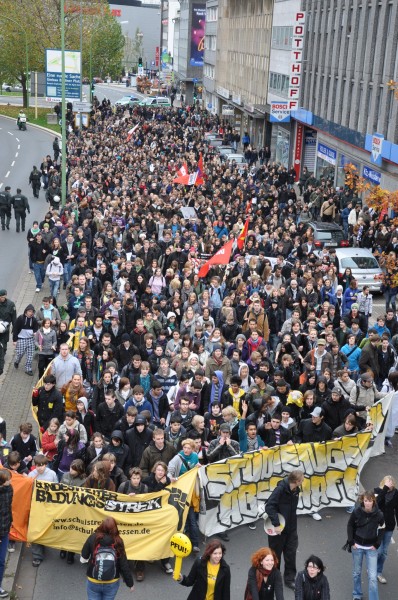 More info...
- 3,000 protesters on a demonstration in Essen; police attacks demonstration: 154 temporary arrests [lerex.de]
- Further demonstrations took place in the following cities (with the number of protesters in brackets): Aachen (2,000; pix), Wiesbaden (10,000), Berlin (25,000; youtube.com), Heidelberg (2,500), Munich (10,000), Mainz (3,000), Darmstadt (500), Osnabrück (2,000; pix), Düsseldorf (4,000), Potsdam (1,000), Jena (1,500), Bonn (2,500), Bochum (700), Hannover (1,000), Cologne (3,000, pix), Regensburg (1,000), Freiburg (5,000; report), Karlsruhe (500), Duisburg/Essen (3,000) and Nürnberg (5,000) = a total of ~ 83,200 protesters
- Lecture halls were occupied by students in Germany at the following institutions: College of Education in Weingarten, Georg-Simon-Ohm University of Applied Sciences (Erlangen; pix), University of Nürnberg-Erlangen (largest lecture hall "Audimax" in Erlangen), University of Applied Sciences in Kaiserslautern, University of Bonn [but evicted by police force shortly; pix], University of Applied Sciences in Potsdam, University of Augsburg [pix], University of Erfurt, University of Münster [re-occupied after eviction on Nov.6th], University of Jena [although police was using pepper spray on campus], Academy of Fine Arts in Nürnberg, University of Passau, University of Paderborn, University of Cologne, University of Tübingen [re-occupied after eviction on Nov.11th], University of Trier, Otto-Friedrich University of Bamberg, University of Karlsruhe, University of Siegen, Technical University of Braunschweig and Academy of Arts in Braunschweig.
University sit-ins spread throughout Switzerland
 Hundreds of students have occupied the biggest lecture hall at Bern University, preventing more than 1,000 other students from attending lectures.
The protests have taken place as part of Global Week of Action – motto "Education is not for sale" – which has seen students targeting the educational machine in several European cities. In Switzerland lecture halls have been occupied in Basel, Zurich and Bern.
Continue to read this text..."Around 1,200 students have been affected," said Christoph Pappa, Bern University's general secretary. "The university administration has noted the protests, but we still don't know what their concrete demands are."
Around 100 students spent Tuesday night in the auditorium – something that hadn't been planned but followed on spontaneously from events earlier in the day - International Students' Day - when some 300 students occupied the auditorium.
The main grievances are the implementation of the Bologna reforms, the commercialisation of education (in the form of industry sponsorship), student fees and the fact that university syllabuses are allegedly becoming more like those in schools.
The Bologna educational reforms are part of the European Union's 1999 Bologna Declaration, signed by Switzerland and 45 other countries. The idea behind Bologna is to harmonise qualifications across Europe so that students and staff can move freely between universities, and the degrees they hold are recognised in every country.
Pappa pointed out that surveys last year revealed that most students judged the Bologna reforms positively.
Nevertheless he said he sympathised with criticism of certain elements of the reforms, such as the fact that instead of being given responsibility and encouraged to think for themselves, students were being spoon-fed information for regular tests.
Problems
This "exam factory" complaint was echoed by Daniel, a geography and history student.
"The big problem is that the Bologna process stops education," he told swissinfo.ch beneath a hammock in Bern University's auditorium on Wednesday.
"You can't reflect on things because you no longer have time to think and to try to go really deeply into a subject. It's not an education."
He added that another big problem in Switzerland was that the Bologna process had been in force for ten years "so people are used to it – it's not like in Germany where everything is new".
"I've been into politics for a long time so I have a solid understanding about why things are going wrong – neo-liberalisation and capitalist structures – but I think a lot of people have a feeling that things are no longer what they should be but they can't really articulate what they think, and that's a big problem."
Commercialisation
Another issue discussed in the auditorium was whether the public education system was still serving the interests of the public, or whether the focus was shifting to implement education systems that primarily serve private and business interests.
"We're concerned that the university is becoming a place where economics comes first and then education. We want a free and critical education – not some sort of training for employment," Luca, a sociology student, told swissinfo.ch.
He added that this creeping commercialisation of education was more of a problem in natural sciences "where Novartis and companies like that sponsor [courses]", but he feared that "if nothing changes, we'll see other companies trying to influence what is taught".
On Wednesday the Swiss Trade Union Federation said in a statement it was delighted by the strong participation and expressed solidarity with the students in Basel, Zurich and Bern in particular.
Support
Michael, studying economics and political science, told swissinfo.ch he wasn't surprised by the level of support.
"I think there are many students who are angry. You can't see it in everyday life as you have a tough programme and exams, but then things happen that make people angry," he said.
"For example, the political sciences institute has just scrapped a module on the social sciences BA without telling the students who subscribed [to that course]. They are now arriving without knowing that they are in fact studying something else."
He believed many people were interested in the issues, but never got around to doing anything about it.
"But when you have something like this, you see many people protesting – and not just people who normally demonstrate but a wide variety of students. This is very important and positive."
Daniel, when asked how long the occupation of the auditorium would continue, was philosophical.
"It depends how long people want to stay.
Student protests all over Italy
According to Unione degli Studenti (UdS), 150 000 pupils and students in more than 50 cities across Italy took to the streets to protest education reforms and the increasing commercialisation and privatisation of public education.
More infos...The following list of cities (and number of protesters in brackets) was published by UdS: Rome (10,000), Turin (15,000), Genoa (5,000), Naples (10,000), Bari (7,000), Lecce (2,000), Florence (3,000), Cosenza (3,000), Salerno (8,000) and many other cities.
More infos...The following list of cities (and number of protesters in brackets) was published by UdS: Rome (10,000), Turin (15,000), Genoa (5,000), Naples (10,000), Bari (7,000), Lecce (2,000), Florence (3,000), Cosenza (3,000), Salerno (8,000) and many other cities.
sexta-feira, novembro 20, 2009
quinta-feira, novembro 19, 2009

segunda-feira, novembro 16, 2009


domingo, novembro 15, 2009
Mass student protests in Denmark
On the 6th of October, 30 000 students gathered in the cities of Copenhagen, Aarhus, Viborg, Odense, Sønderborg and Aalborg, to protest against budget cuts in Danish school. Furthermore 60 schools were occupied by the students at least one day before the demonstration. The name of the campaign and the initiative organizing the protests is called Out of the crisis – into the future and consists of all the students organizations of Denmark and the young trade-union movement.
 “The government has made cut downs every year for the last 10 years and it’s the wrong way to go in an economic crisis”, says the spoke man of the initiative and the president of the organization of Danish upper secondary school students (DGS) Bjarke Dahl Mogensen. “Education is the future and to inject money to education is an investment. The vocational school students don’t have training places and in upper secondary school we sit way too many students in the class rooms. The unemployment of youth is increasing enormously – we don’t want to be garbage generation, we need investments and action from the politicians!”
Since the demonstration in the beginning of October more money have been promised to the university students and party of the opposition have said that they will vote for a limit of size of the classrooms – so now there is majority for a limit if we get a new government. The supporting party of the Danish government has said that they will not vote for budget cuts on education. But if they do what they have promised is doubtful, since the final reading of the Budget proposal is still waiting. So the Danish students continue the fight.
“The government has made cut downs every year for the last 10 years and it’s the wrong way to go in an economic crisis”, says the spoke man of the initiative and the president of the organization of Danish upper secondary school students (DGS) Bjarke Dahl Mogensen. “Education is the future and to inject money to education is an investment. The vocational school students don’t have training places and in upper secondary school we sit way too many students in the class rooms. The unemployment of youth is increasing enormously – we don’t want to be garbage generation, we need investments and action from the politicians!”Since the demonstration in the beginning of October more money have been promised to the university students and party of the opposition have said that they will vote for a limit of size of the classrooms – so now there is majority for a limit if we get a new government. The supporting party of the Danish government has said that they will not vote for budget cuts on education. But if they do what they have promised is doubtful, since the final reading of the Budget proposal is still waiting. So the Danish students continue the fight.
«Equidade no Ensino Superior», opinião de Sandra Monteiro (directora do «Monde Diplomatique» PT)
Nos últimos vinte anos, o ensino superior em Portugal passou por profundas transformações, do modelo de financiamento ao novo regime jurídico das instituições do ensino superior, passando pela reforma de Bolonha e pelas alterações do estatuto da carreira docente. O início da nova legislatura, até porque combina uma solução de continuidade na pasta do Ensino Superior com uma previsível revitalização do debate político e parlamentar, é um bom momento para a sociedade reflectir criticamente sobre todas estas alterações, para fazer um balanço que tenha em conta os dados empíricos entretanto disponíveis e para ajustar os caminhos futuros de um ensino superior democrático e de qualidade.
Poderá começar-se pelo modelo de financiamento. Há quase duas décadas opuseram-se duas concepções. A primeira correspondia à defesa do contrato social até então em vigor e apoiava-se no texto Constitucional, que prevê que o Estado deve assegurar o carácter universal e tendencialmente gratuito do ensino. Afirmava que o ensino superior deve constituir um serviço público cujo funcionamento corrente deve ser financiado pelo orçamento de Estado, de modo a que uma fiscalidade progressiva actue como mecanismo de redistribuição do rendimento e de promoção da justiça social, propiciando a todos, independentemente da origem socioeconómica da família em que se nasceu, condições de maior equidade no acesso ao saber e ao desenvolvimento das competências susceptíveis de propiciar uma sociedade menos desigual. Um regime de bolsas e de apoio social deveria ajudar a superar as situações de exclusão prevalecentes.
A segunda concepção defendia o fim da «gratuitidade» do ensino superior – que supostamente desresponsabilizava o aluno e desvalorizava o grau –, o que devia ser feito através da introdução de propinas, mais ou menos aproximadas do custo real do ensino, segundo as versões, como forma de assegurar o aumento da qualidade das formações e dos diplomas. Esta perspectiva sustentava ainda que o novo modelo de financiamento, através de diferentes escalões de pagamentos e isenções, faria com que os estudantes de maiores rendimentos pagassem propinas mais elevadas, para financiar o ensino dos estudantes mais pobres. A Lei 20/92, de 14 de Agosto, promulgada durante o governo de Aníbal Cavaco Silva no quadro de uma intensa contestação estudantil, fez até questão de sublinhar a ideia de que as propinas não serviriam para desresponsabilizar o Estado e pagar as despesas correntes (salários, etc.), definindo-as como receitas «a afectar, prioritariamente, à prossecução de uma política de acção social e às acções que visem promover o sucesso educativo». Prioritariamente... A cada instituição incumbia a fixação anual do montante das propinas, com base num valor máximo definido pelo Conselho de Reitores das Universidades Portuguesas (CRUP), e pelo órgão equivalente no ensino politécnico.
Do preço simbólico de 1200 escudos (cerca de 6 euros) antes da nova lei, as propinas passaram a ter um valor médio de 300 euros em 1995 e de 900 euros em 2005. Hoje, quase todos os estabelecimentos públicos, confrontados com um crónico subfinanciamento estatal que põe em causa o normal funcionamento das instituições, aplicam a propina máxima (972,14 euros), uma das mais altas da União Europeia (só dois países praticam valores mais elevados e sete não cobram qualquer montante). O modelo de financiamento com propinas, além de não ter contribuído para melhorar a qualidade do ensino, promoveu o recurso ao crédito bancário por parte de muitos estudantes que, não podendo agora cumprir com os pagamentos, são forçados a desistir do ensino superior.
Poder-se-ia pensar que esta é uma situação nova, mas um estudo de Belmiro Cabrito, professor no Instituto de Educação da Universidade de Lisboa, intitulado «Equidade no Ensino Superior – 1995-2005: Uma Década Perdida?», veio recentemente demonstrar que, já antes da crise, «o elitismo da universidade portuguesa agravou-se», afastando numa década um terço dos alunos mais pobres (a percentagem passou de 12,5 para 8,5 por cento). O estudo verificou também que «o aumento do número de bolseiros (no privado, sobretudo) não teve efeitos positivos na equidade do ensino universitário», que permanece bastante baixa.
Poderá este ser o caminho de uma modernização assente na formação de competências e na justiça social? Se a prioridade «é desenvolver as políticas sociais, é qualificar os serviços públicos, é reduzir as desigualdades na sociedade portuguesa», então não podemos perder mais décadas.
É absolutamente de LEITURA OBRIGATÓRIA este artigo de opinião de Sandra Monteiro, publicado na edição de Novembro do «Le Monde Diplomatique - edição portuguesa».
sábado, novembro 14, 2009

Estudantes alemães ocupam [várias] Universidades em protesto contra o pagamento de propinas
Estudantes alargaram os protestos contra o pagamento de propinas ocupando instalações de universidades em Berlim e Munique.Em Munique, centenas de estudantes ocuparam a Aula Magna da Universidade Ludwig Maximilian e resolveram manter-se em debate permanente sobre a reforma do ensino superior naquelas instalações.
Em Berlim, estudantes da Universidade Livre e da Universidade Humboldt ocuparam também salas de aula e fizeram plenários para aprovar moções de protesto. As ocupações deverão manter-se nos próximos dias, disse um porta-voz dos manifestantes.
Em Tuebingen, no sul da Alemanha, a polícia pôs fim à ocupação da Universidade local por cerca de 200 estudantes, que depois de alguma resistência abandonaram pacificamente o campus universitário.
Outras reitorias, como as das universidades de Berlim, por exemplo, preferiram dialogar com os estudantes e negociar um prazo para abandonarem as salas de aulas.
Segundo a comissão coordenadora dos protestos, os estudantes ocuparam instalações universitárias em 20 cidades do país. Tudo começou há alguns dias na Universidade de Viena (Áustria), onde um grupo de estudantes exigiu melhores condições de trabalho e estudo. Entretanto, os protestos alastraram a vários países da Europa, embora as revindicações sejam diferentes.
Os estudantes alemães exigem sobretudo a abolição do pagamento de propinas e criticam a implementação dos chamados cursos de Bolonha, que se destinam a unificar o ensino superior na União Europeia, e a substituir as clássicas licenciaturas de cinco anos por um bacharelato de três anos, seguido ou não por um mestrado de dois anos.
Em declarações à emissora pública SWR, a ministra do Ensino Superior alemã, Annete Schavan, pediu aos governos estaduais, que constitucionalmente têm a tutela do ensino, para acelerarem as reformas do Processo de Bolonha. "A política educativa tem de ser credível e as matérias desnecessárias têm de ser suprimidas dos cursos, para aliviar a carga horária dos estudantes", defendeu a ministra democrata-cristã.
A oposição alemã solidarizou-se com os estudantes e acusou Annete Schavan de culpar os governos estaduais pela má situação no ensino superior.
Alunos da Universidade de Brasília tiram a roupa em apoio à estudante da Universidade Bandeirante
Cerca de 100 alunos da Universidade de Brasília (UnB) ficaram nus ou seminus, nesta quarta-feira [11 de Novembro], durante uma manifestação de apoio a Geisy Arruda, a estudante de Turismo que chegou a ser expulsa da Universidade Bandeirante (UniBan), em São Bernardo do Campo (SP), por assistir [às] aulas usando um vestido curto.
 "Pela liberdade de expressão e o fim da opressão machista", diziam alguns cartazes usados no protesto dos estudantes da UnB.
No último dia 22 [de Outubro], Geisy teve que deixar a UniBan de São Bernardo do Campo sob escolta policial depois de ser hostilizada e agredida verbalmente pelos estudantes da instituição simplesmente por usar o vestido curto.
O grupo comparou o caso da UniBan com situações de preconceito e machismo registados na UnB. Um exemplo citado durante a manifestação foram os actos de violência sexual ocorridos na Universidade, como o ataque a uma estudante de 18 anos, em Abril deste ano.
A estudante de Serviço Social e militante do Klaus, grupo da causa GLBT da UnB, Luana Gaudad, 20 anos, afirmou que "Todos os dias as mulheres e outras minorias sofrem agressões na Universidade. São agressões verbais, falta de segurança e assédios por parte de professores e funcionários. Todas as minorias, aqui, estão vulneráveis e expostas".
O protesto foi convocado pelos alunos da Sociologia, e rapidamente se espalhou por email e pelo Orkut. "Acreditamos que o movimento estudantil, assim como o movimento social, não pode aceitar nenhuma forma de agressão, machismo ou preconceito", disse Rodolfo Godoi, estudante de sociologia.
No domingo passado, a UniBan anunciou que tinha decidido expulsar Geisy devido a sua "flagrante falta de respeito aos princípios éticos, à dignidade académica e à moralidade". A onda de protestos gerada pela decisão da Universidade foi tamanha que levou a instituição de ensino a readmitir a estudante dois dias depois de expulsá-la.
quarta-feira, novembro 11, 2009
terça-feira, novembro 10, 2009
London College of Communication occupied
Courses in Creative Enterprise and the Printing Schools and some staff members have been earmarked for redundancy by Sandra Kemp, the Head of College (appointed in February 2009) in order to align the LCC it with its "core strengths" and make up for a deficit of £1.3 million. A possible restructuring plan was communicated with just two members of the SU: Helen Gimber, SU President and Andrea Strachan, SU General Manager in late June 2009. This restructuring will mean that a number of courses in the Printing and Creative Enterprise schools will be closed. This includes the popular BA Marketing and Advertising and MA Marketing Communications degrees. From the Creative Enterprise school, only courses in PR and Creative Advertising Strategy will survive the restructuring plans. These measures involve not only high staff redundancy numbers, but also the devaluation of the degrees of thousands of current students and alumni.
segunda-feira, novembro 02, 2009
Um caderno de encargos para o Ensino Superior
Em primeiro lugar, a urgência de ordenar a oferta educativa. Existem cerca de 4000 cursos registados, sendo 1874 de licenciatura ou de mestrado integrado, com mais de 800 designações distintas. Esta diversidade não é uma mais-valia do sistema e dificulta a sua legibilidade.Foi com espírito de colaboração e de abertura que, ainda antes de se iniciar a actual legislatura, apontei um conjunto de objectivos que poderiam constituir o Programa do Governo na área do Ensino Superior.
Defendo que cursos com um conteúdo nuclear semelhante tenham a mesma designação e que cursos com um conteúdo nuclear diferente tenham designações diferentes, o que não acontece actualmente.
Um equilíbrio satisfatório poderia ser que a definição da designação dos cursos de 1º ciclo e de mestrado integrado fosse feita em sede de regulação, ficando os restantes ao critério das instituições.
Um segundo ponto passa pela racionalização da rede pública de instituições.
Quinze universidades, quinze politécnicos e quatro escolas não integradas, sem qualquer política de articulação entre elas ou programa de financiamento que a sustente, fazem do nosso sistema apenas um somatório de partes.
Venho propondo a criação de Regiões Académicas, agrupando ou articulando numa base regional as instituições. Apesar de esta ideia ser autorizada pelo actual RJIES, é necessário que o Governo promova, por sua própria iniciativa, a criação de mecanismos de coordenação.
Uma terceira acção é a de repensar toda a política de financiamento. É necessário fechar o actual ciclo de estrangulamento financeiro das Universidades que, nos últimos cinco exercícios, representou uma redução de 30% do esforço público de financiamento para funcionamento, medido em percentagem do PIB.
É necessário construir um novo modelo de financiamento numa base plurianual, quer em termos de funcionamento, aproximando-nos dos valores médios europeus, quer em termos de investimento, contratualizando Planos de Desenvolvimento em função dos objectivos pedagógicos e científicos.
É necessário ainda que o binómio Acção Social/Propinas seja analisado, tendo como certo que as portas do Ensino Superior actualmente se fecham, por razões económicas, a uma parte da população, que é necessário aumentar a taxa de escolaridade neste nível de ensino e que as propinas são das mais elevadas da Europa.
Em quarto lugar, é necessário clarificar o conceito de autonomia.
Com as recentes reformas da administração pública e o RJIES, temos hoje um quadro de funcionamento, em termos dos constrangimentos burocrático-administrativos, ainda mais limitativo do que há quatro anos. Entreabre-se a possibilidade de aproveitar a via das fundações públicas de direito privado, mas urge que se definam com clareza os mecanismos simplificados que esta via comporta.
O quinto e o sexto pontos apontam, respectivamente, para o retomar do processo de avaliação, corrigindo o erro que constituiu a interrupção do sistema de avaliação antes de pôr a funcionar uma alternativa, e para uma reaproximação entre as Universidades e o sistema científico – sabendo que nenhum país pode ambicionar a um sistema científico de qualidade sem assegurar igualmente o desenvolvimento das suas instituições universitárias.
Fernando Seabra Santos
Reitor da Universidade de Coimbra e presidente do CRUP
sexta-feira, outubro 23, 2009
Propinas afastam um terço dos alunos mais pobres
Cerca de um terço dos alunos de baixo rendimento deixaram a universidade entre 1995 e 2005.O aumento de propinas levou ao afastamento de alunos de famílias com baixos rendimentos.De 1995 a 2005, período em que foi introduzido o modelo de propinas nas universidades, o ensino superior ficou mais elitista. Foi esta a conclusão apresentada por Belmiro Cabrito na sua intervenção no FES 2009 [O financiamento do Ensino Superior], conferência dedicada ao financiamento superior organizada pela Universidade de Lisboa (UL).
Segundo os números apresentados pelo professor do Instituto de Educação da UL, a percentagem de alunos de rendimento baixo no ensino superior desceu um terço nesses dez anos, especificamente de 12,5% para 8,5%. Quase todos esses alunos foram ‘substituídos' por estudantes que vêem de famílias de rendimento médio, com a percentagem a subir de 69,9% para 73,8%. A percentagem de alunos de rendimento alto e médio alto manteve-se essencialmente igual, passando de 17,6% para 17,7%.
Belmiro Cabrito comparou estes números com os dados da população geral do censo de 2001, que dividiam o país em 9,9% de rendimento alto e médio alto, 52,1% de rendimento médio e 38% de rendimento baixo. "O grau de equidade da universidade portuguesa, é bastante baixo, remetendo para uma universidade ainda de elites. Em termos evolutivos, o elitismo da universidade portuguesa agravou-se", conclui o economista. "Esta tendência é notória e deve-se provavelmente à nova política de propinas. Em 1995 a média de pagamento de propinas era de 300 euros. Em 2005 passou a ser de 900 euros".
A primeira intervenção do dia coube a Luísa Cerdeira, que apresentou algumas das conclusões retiradas de um inquérito realizado em 2005 a uma amostra de alunos universitários. No que respeita às propinas, os estudantes responderam que, se estas aumentassem menos de 50%, os alunos tenderiam a ir trabalhar para pagar os estudos. Se o aumento fosse para mais de 50%, a tendência é para abandonar os estudos, sendo que essa tendência é maior ainda no ensino privado.
"Os alunos consideram que o ensino superior é um bem público que deve ser suportado pelo Estado e não concordam que as propinas sejam um factor de melhoria da qualidade do ensino", lembra a administradora da UL. A maioria também discorda da criação de um valor da propina ajustado em função do rendimento esperado após a obtenção da formação superior.
O papel do Estado
Outro dos valores comparados na sessão remeteu para a comparticipação do Estado no financiamento do ensino superior, mantendo-se a tendência que aponta para valores de 44% para o Estado e 56% para os estudantes. "Não houve mudanças significativas no sentido de uma maior participação do Estado na prestação de um serviço público. Estes valores tornam-se ainda mais significativos se compararmos o dinheiro que cada um destes grupos tem à partida", comentou Belmiro Cabrito.
Nicholas Barr, professor inglês que esteve presente no primeiro dia da conferência e é conhecido como um dos maiores defensores do sistema de propinas, utilizou a sessão de debate para defender esse modelo. "É importante fazermos uma distinção. Uma questão é dizermos que o ensino superior deve ser acessível aos mais desfavorecidos, o que deve acontecer. Outra bem diferente é dizer que o Estado o devia disponibilizar de graça", defendeu o professor dando o exemplo de um bem essencial como o da comida. "Querer facilitar a compra de comida para famílias mais pobres não quer dizer que ela deva ser disponibilizada de graça para todos".
Em resposta a esta teoria, Belmiro Cabrito lembrou que, embora a compreenda, "num país com 38% dos seus cidadãos com rendimento baixo, recuso-me a acreditar que só 8,5% não sejam ‘atrasados' em relação ao resto da população".
quarta-feira, outubro 21, 2009

sexta-feira, outubro 16, 2009
La ricerca è in bilico, non tagliate la corda: azione dei ricercatori precari alla Sapienza
Precari e studenti della Sapienza manifestano contro il governo mentre Napolitano e Frati premiano le migliori ricerche. Come sul Titanic. Il presidente della repubblica Napolitano visita la Sapienza per premiare i ricercatori meritevoli, gli studenti, i dottorandi e i ricercatori precari protestano: in due si calano dai tetti della facoltà di Lettere reggendo uno striscione che recita "La ricerca è in bilico, non tagliate la corda". L'azione di oggi si inserisce nella campagna "La Gelmini non ci merita" e rilancia le mobilitazioni di questo autunno contro i tagli e la riforma annunicata dal governo per fine Ottobre.
Gli studenti e i precari dell'università "La Sapienza" di Roma hanno manifestato durante il convegno in cui il presidente Giorgio Napolitano e il rettore Luigi Frati hanno premiato le migliori ricerche dell'ateneo. Letteralmente appesi a venti metri d'altezza, un ricercatore precario e una studentessa hanno aperto uno striscione con il messaggio "La ricerca è appesa a un filo, non tagliate la corda" davanti al Rettorato. La protesta è continuata anche durante la premiazione in Aula Magna: sono stati esposti cartelli che richiamavano all'attenzione del presidente della Repubblica i provvedimenti del ministro Gelmini sull'Università e sulla ricerca.
Gli studenti e i precari dell'università "La Sapienza" di Roma hanno manifestato durante il convegno in cui il presidente Giorgio Napolitano e il rettore Luigi Frati hanno premiato le migliori ricerche dell'ateneo. Letteralmente appesi a venti metri d'altezza, un ricercatore precario e una studentessa hanno aperto uno striscione con il messaggio "La ricerca è appesa a un filo, non tagliate la corda" davanti al Rettorato. La protesta è continuata anche durante la premiazione in Aula Magna: sono stati esposti cartelli che richiamavano all'attenzione del presidente della Repubblica i provvedimenti del ministro Gelmini sull'Università e sulla ricerca.
terça-feira, outubro 06, 2009
Asia rising: Countries funnel billions of dollars into Universities
Across East Asia, governments are funneling resources into elite universities, financing basic research, and expanding access to vocational and junior colleges, all with the goal of driving economic development.Students work at terminals in a state-of-the-art library at Tsinghua University in Beijing. China is plowing money into top universities while also establishing vocational programs and enabling more students to go to college.
Hong Kong and Singapore, compact port cities that have lost their traditional importance as logistics and manufacturing centers, are rushing to turn themselves into centers of innovation.
China has invested in a group of select universities that it hopes will become globally renowned hubs of technological and scientific research, while in South Korea, leaders are spending billions of dollars on projects designed to spawn top-notch laboratories and attract foreign universities as partners. And as Taiwan's economy loses ground to China, it is trying to draw top talent through aggressive international recruitment.
Asia's approach to higher education contrasts markedly with that of the United States, where, even before the global recession hit, the percentages of state budgets dedicated to higher education have been in steady decline.
"Out here the government is looking at education as a driver of the country's future, so it isn't last in line," says Rajendra K. Srivastava, provost of Singapore Management University, who spent 25 years at the University of Texas at Austin.
Continuar a ler o artigo...As American educators fret over a "dropout crisis," some Asian countries report graduation rates in the 90th percentile. Many of those graduates are in strategic fields like engineering. Jee-Yeon Kim (above) studies electrical engineering at Korea's National NanoFab Center. The goal is to produce students who will contribute to indigenous research.
In Texas, he recalls with dismay, "when they were allocating the state budget, education was one of the last things to get approved."
But while the government-led push is quite different from America's decentralized approach, Asian college and government officials say they are taking cues from the United States. Specifically, they hope to replicate America's post-World War II path to growth.
"Asians have studied very carefully the reasons why Western populations are now successful," says Kishore Mahbubani, a dean at the Lee Kuan Yew School of Public Policy at the National University of Singapore and author of The New Asian Hemisphere: The Irresistible Shift of Global Power to the East. "They realize that unless you create good universities and attract the best minds in the world, you can't move into the next phase of development."
All this is against the backdrop of declining American dominance in global research. A 2008 National Science Foundation report found that patents filed by inventors living in the United States had dropped from 55 percent in 1996 to 53 percent in 2005. The foundation attributed the change to an increase in filings by Asian inventors.
The U.S. share of "highly influential" papers published in peer-reviewed journals also fell, from 63 percent in 1992 to 58 percent in 2003—a drop that reflects the rise of China, Singapore, South Korea, and Taiwan, the report's authors noted.
"Innovation and its handmaiden, R&D, is driving the global economy," they continued, "and we are seeing more nations recognize this by creating their own version of U.S. research institutions and infrastructure."
The United States continues to lead the world by most measures, including financial support for higher education, top scholarly work, and the production of patents. But Asia is emerging as an increasingly strong competitor.
"It's not so much that the U.S. is on the decline but that the Asian universities are rising," says Gerard A. Postiglione, an expert on Chinese education at the University of Hong Kong. "They're rising along with their economies."
A Shift in Power
Those economies, like their Western counterparts, have foundered in the past year. The South Korean won plunged to an 11-year low in March. Singapore's economy is in a crippling slump, with its Trade and Industry Ministry predicting a contraction of 4 to 6 percent by the end of the year. Hong Kong will probably show a similar drop, and Taiwan has seen a double-digit dip in exports over the previous year. Only China posts continued growth, but the country's future is uncertain, with development likely to augur the death of its manufacturing economy as China prices itself out of the cheap-labor market.
But while many U.S. states slash their higher-education budgets, East Asian countries have faced the crisis by funneling more resources into the future. Certainly the stimulus bill approved by the U.S. Congress this year earmarked millions of dollars for higher education. But that money will run out in the next couple of years.
In contrast, recovery financing in China, South Korea, and Singapore supports basic research and the creation of programs in key fields for innovation. The assumption is that such projects will boost economic growth.
"What we see out here is that if we can get a better educated population it will attract the higher-value industries," says Mr. Srivastava. "We're trying to move up the growth ladder."
Inviting Partners
Whether investment in higher education directly translates into a robust economy, which also depends on factors like tax and trade policies, and an overall culture of innovation, is debatable. But Asia is steaming ahead on faith.
Intent on repositioning its economy around biotechnology and medical sciences, Singapore has invited graduate programs from leading American universities, including the University of Chicago, the Massachusetts Institute of Technology, and Duke University, to set up in the tiny city-state, housing them in campuses near state-of-the-art science parks to facilitate the development of spin-off companies.
South Korea hopes do the same with undergraduate institutions. Its Songdo Global University Campus, a new development on Songdo, a man-made island in the Yellow Sea, is designed to entice foreign universities to establish branch campuses, with the goal of enrolling 12,000 students by 2012. The project's developer hopes the universities will interact with the research arms of multinational companies, turning Songdo into a global business hub.
In 2005, Taiwan allocated $1.6-billion for elite universities, aiming to have 10 of Asia's top universities or departments by 2010.
"Every university here is putting a lot of effort into increasing the number of English-language programs," says Angela Fan, deputy dean of international affairs at National Yang-Ming University, in Taipei.
In its bid to become "Asia's world city," Hong Kong is advertising generous research money and relaxing caps on international enrollment. In 2012 its universities will switch from a three-year system inherited from the British to a four-year program with a broader curriculum—a move designed to make them more competitive.
And China is doing everything at once. The country has attracted attention for its success in jump-starting its top universities through a plan known as the 985 Project. But the country's policy makers are equally focused on improving access and overhauling vocational education. Plans include expanding access to higher education on a scale comparable only with postwar America. "They're developing a strategy of walking on two legs," says Qiang Zha, an expert on Chinese higher education at York University, in Toronto.
A Shifting Power Dynamic
The effectiveness of these campaigns varies, but few dispute that East Asia's higher-education push has produced some notable results. With the exception of Taiwan, all the East Asian upstarts now have universities in the top 100 on the Times Higher Education-QS World University Rankings (although they rank much lower on the more research-focused "Academic Ranking of World Universities," by Shanghai Jiao Tong University).
One measure of Asia's impact is its effect on countries that traditionally dominate global higher education. In 2006 experts at the Organization for Economic Cooperation and Development prepared a report for the Lisbon Council, a Brussels-based research group, praising South Korea for near-universal high-school education and noting the rise of China and India. The report stressed, "There is no way for Europe to stop these rapidly developing countries from producing wave after wave of highly skilled graduates."
Ma Wanhua, a professor at Peking University Graduate School of Education, spent last year on a fellowship in Germany, where she says she was frequently approached with questions about Chinese policy. "Many European countries are starting to think about the 985 Project as they try to build up their own research universities," she says.
The power dynamic is shifting within the region as well, with China making the biggest waves. Analysts say Japan unveiled its Centers of Excellence program, which entails generous grants to select institutions, in response to China's reforms.
Michael Spence, vice chancellor of the University of Sydney, recently said he fears losing Chinese students—which at his institution make up 40 percent of international students—not to universities in the West but to China's own.
Regional development is not a zero-sum game. Discoveries published in international journals are available to all researchers, and strong Asian universities can be a boon for Western academics seeking collaborators. Better training also means more qualified candidates for U.S. graduate programs.
But while it is impossible to know how many Chinese students now choose China over, say, Australia, it is clear that more now elect to stay close to home. Unesco's "2009 Global Education Digest" found 42 percent of mobile students in East Asia and the Pacific remained within the region in 2007—up from 36 percent in 1999.
No Choice but to Change
Concern over Asia's rise is hardly new. "The idea that the U.S. is falling behind Asia in education is an old one," says Ann White, director of the Institute of International Education, in Hong Kong. "I remember hearing it when I was in university 25 years ago."
Hysteria about the loss of U.S. dominance dates to the 1950s, when pundits sounded alarms about the rise of Soviet universities. Five decades later, Ms. White says, the evidence doesn't bear out the claim that the United States is being eclipsed, pointing out that inquiries at her office from students in Hong Kong, mainland China, and Macau who want to study in the States are at an all-time high.
But others note that even if the United States remains the gold standard for now, Asia already outpaces the States in some important areas. As American administrators fret over a "dropout crisis," Asian countries report graduation rates in the 90th percentile.
Many of those graduates are in fields of strategic importance, like science and engineering. The long-term vision across the continent is of producing students who can contribute to indigenous research.
Asia has few alternatives, policy makers say. Small countries like South Korea may be fine for the next two decades, but beyond that the outlook is grim unless they can spur innovation, says Hee Yhon Song, a longtime economic planner for the Korean government who is spearheading the Songdo Global University Campus project.
"We need to improve the quality of Korean universities fast enough to preserve the technology gap between Korea and China and India," says Mr. Song. "The Chinese tiger is growing fast. If we are too slow, the Korean horse will be attacked."
Demographics are another pressure. Birth rates have plummeted across Asia in the past few decades. Hong Kong, Singapore, Taiwan, and Macau have the lowest birth rates in the world, and South Korea is not far behind.
With the number of graduating high-school seniors dwindling, these countries have to look abroad merely to keep enrollment steady.
Hong Kong has steadily raised its cap on international and mainland-Chinese students at public universities, from 2 percent of the total student body in 1993 to 20 percent today. The famously cramped territory has also marked two swaths of land for the establishment of private universities. The new institutions, which won't be subject to caps, may take students that have been locked out of other universities.
The shrinking number of native-born students is behind Taiwan's internationalization as well. More foreign students will not be enough to save some universities, however; in 2006, the Ministry of Education stipulated that institutions that receive low scores in periodic evaluations will be shut down.
But educators and administrators across Asia talk about the enrollment bind as a positive thing. A sense of urgency persuades leaders to preserve resources for education when policy decisions get tough, says Mr. Song. "If they understand that it's a survival strategy, they allocate the money."
The United States, by contrast, often appears slow to act, in the eyes of Asian administrators.
"The United States has been dominant for so long that it tends to take its position for granted," says Jongryn Mo, dean of Underwood International College at Yonsei University, in Seoul. "I am not sure if it understands the challenges arising as the rest of the world catches up."
U.S. Example, Asia Autocracy
It helps that several East Asian powers are governed by technocrats who are adept at making sense of economic forecasts. These leaders were educated at American universities, where they saw how the higher-education system worked firsthand. Now they hope to replicate it.
In China, policy makers looked closely at the California system's master plan before coming up with their two-pronged approach of simultaneously developing mass and elite institutions, says Mr. Zha, the Chinese higher-education expert in Toronto.
Others say infusions of cash to elite universities in Korea, Taiwan, and China are a nod to America's hierarchy of universities.
"The Korean system is very much the U.S. system," says Nam Pyo Suh, president of Korea Advanced Institute of Science and Technology, explaining that the country's private universities outnumber its public institutions, and only a small number of those are allowed to excel.
But the abrupt creation of an elite group of universities in South Korea, China, and Taiwan has yielded resentment at institutions excluded from the financial trough.
"We were given a lot of money," says Ms. Ma, referring to Peking University, "and people say, 'What have you done with it?'"
And while Asia's rise may be cut on a U.S. model, the continent's strong commitment to education grows out of a very different style of governance.
Autocratic governments like China and Singapore have the luxury of planning two or three decades in advance. China, which routinely maps out targets to 2050, is expected to unveil a long-term plan for higher education soon—a document that would be unthinkable in the United States. Such countries also have an easier time pushing through unpopular measures, such as mandates that universities offer a set portion of courses in English, which tend not to sit well with faculty members who didn't study overseas.
"In Asia, there's a belief that you need strong government intervention to create good universities," says Mr. Mahbubani, of the National University of Singapore. "In the U.S. there is an assumption that the government does not need to intervene because society will somehow work things out."
Some Asian observers now hold up the global economic crisis as proof that government intervention is necessary. A financial mix that includes substantial endowment money, for example, is feasible only when an economy is in full swing. U.S. universities, Mr. Mahbubani points out, are suffering: "I don't know how they're going to cope in hard times."
An Asian Model?
Beyond a financial and policy commitment, however, it is difficult to discern a larger pattern in Asia's education push. At the Asia-Pacific Association for International Education meeting in Beijing this past spring, some representatives hinted at developing an Asian answer to the Bologna Process, the European effort to adopt uniform degree standards. But most agreed such a process is still far off.
"Asia has always put a lot of emphasis on education for economic development," said Anthony Cheung, president of the Hong Kong Institute of Education, as he prepared to host a group of Asian university presidents in May. "Now we need to see whether there are any commonalities in our approaches."
At the national level, those approaches have their detractors. Professors in South Korea complain that students study hard in high school—and then abruptly stop.
"They speed up and up until they pass the gate of the university," says Shin-wha Lee, professor of international relations at Korea University. "They don't read Tolstoy, they don't read about democracy, they don't read Marx."
Asia's high graduation rates may simply reflect a lack of academic rigor. In Korea degree attainment is such a sure bet that in the early 1980s the country briefly instituted a "graduation quota" that, before popular protest forced the government to drop it, required universities to fail a specific number of students.
And some say China's push has happened too fast. In the past 10 years, universities were cut loose from central-government financing and encouraged to balance their books. But tuition remains tightly controlled by the government, a gap that forced many universities to take out high-interest loans from local banks. Today many are in debt.
China's student-faculty ratio has skyrocketed, meanwhile. Even with millions of young people vying for scarce jobs, employers complain about the quality of recent graduates.
"China has moved from an elite system to a mass one in five or six years," says Mr. Zha. "In other countries it took 15 or 20 years to accomplish that jump."
In a report released this May that contrasted in tone with its earlier warning about the rise of Asia, the OECD said China needed to raise its spending on higher education to ensure quality. Similarly, in 2003, the consulting firm McKinsey emphasized that quantity is not everything, estimating that only 10 percent of China's 1.6 billion engineers are qualified to work in multinational companies.
Cooperating Across Borders
But in the long run, financing across the region seems secure. The East Asian countries are moving closer, meanwhile, by cooperating on research and dual-degree programs. In crafting a fourth public university, Singapore has settled on two collaborators that reflect the city-state's dual orientation, courting an unnamed Chinese university along with the Massachusetts Institute of Technology. And Taiwan is debating whether to admit students from China, a potentially historic move for two countries that still have no diplomatic ties.
Hong Kong's leading universities, meanwhile, are building branch campuses across the border with mainland China in Shenzhen, in an area once dominated by low-end manufacturing. The goal is to take advantage of Chinese-government funds for basic research, says Thomas Wu, director of academic links at the Chinese University of Hong Kong.
"The government is trying to redo southern China as an area of technology transfer," he explains, adding that his university's Shenzhen program will enroll up to 200 mainland Ph.D. students. "If that succeeds, then increasingly we will have a role as a center of applied research."
Like administrators and policy makers across Asia, he connects his predictions to the economy. "What's very interesting," he adds, "is how the Chinese economy recovers."
quarta-feira, setembro 30, 2009

University of California campuses erupt into protest
Students and faculty members demonstrate against plans to raise tuition fees and cut workers.
In the sweltering California heat with their placards, posters, red armbands and chants of "no cuts, no fees, education should be free", the demonstrators packed in to Sproul Plaza at the centre of University of California Berkeley campus today meant business.
The crowd cheered and passing cars hooted as speakers implored them to fight state authorities' plans to hike student fees and lay off workers.
Daniella, a petite second-year Latina undergraduate sitting quietly in the shade echoed what many making the rallying calls were articulating. "My whole life I wanted to come here. If they increase the fees I will have to drop out. We have to fight this."
The Berkeley protest was one of many held across California in an unprecedented day of action directed at university authorities and state governor, Arnold Schwarzenegger as he attempts to curb the state's multibillion-dollar budget crisis. Faculty, students and unions from the University of California's 10 campuses including its two most prestigious, UCLA and Berkeley, joined forces in what was the biggest student protest for more than a generation.
The scale of the protests has come as a shock to state authorities. What began as a marginal dispute in the summer between university faculty and their management over cuts in salaries has in recent weeks escalated into a statewide walkout by students and faculty as well as a day of strike action by campus technical workers against layoffs and diminished terms and conditions.
The turning point came two weeks ago when university authorities warned of savage budget cuts to deal with a $750m (£466m) shortfall and mooted huge increases in the cost of tuition. "UC regents vote next week to raise student fees, already up 250% over the last decade, by an additional 30%," was how one group of protesters summed up the situation today.
In a move that will reignite debates around racial inequities in education one group demonstrating labelled the proposed hike in fees as "twisted and racist", saying it would mean more low-income and ethnic minority students would be unable to afford a college education. They also criticised proposals to increase the proportion of out-of-state students - who pay markedly higher fees - to 26% alleging it would further reduce the opportunities for young people from low-income groups or ethnic minorities living in California to secure a university place.
In a swipe clearly directed at the governor's office one provocative leaflet read: "Annually the state pays $49,000 per prison inmate and less than $14,000 per UC student. If the state can lock us up, it can invest in our education for one-third of the cost."
A spokesman for the group Graduate Students of Colour said: "Students of colour are asking a crucial question: Why now, and why us? California's population of college-age adults is majority black and brown. Whatever other reasons are cited, that underlying condition is left unspoken."
In recent years student demonstrations in California have been small-scale and largely single issue-led such as those held after Hurricane Katrina when students protested against the Bush administration's response in the immediate aftermath. Signs that the latest protests were different and that feelings were running especially high were evident in the run-up to the walkout with fringe meetings mushrooming across campuses to galvanise support. At UC Berkeley activists could be seen donning red armbands while at UC Davis one preliminary protest yesterday included a "naked" demonstration by a small group of students accusing authorities of "stripping" the education system.
Facebook and Twitter campaigns were also launched while over a thousand faculty members across all campuses signed an online petition rejecting budget cuts and proposing alternative ways to save money such as trimming the salaries of education bosses and senior officials plus tapping into reserve funds.
For many this latest wave of protest in California is reminiscent of the 1960s when UC Berkeley in particular earned a reputation as the epicentre of student activism when it spawned the Free Speech Movement. It was also the last time a former Hollywood actor, Ronald Reagan, was governor. Author and scholar at UC Berkeley's geography department Gray Brechin, who was an undergraduate at Berkeley during the 60s unrest said the current dispute had been "simmering" under the surface for months.
He said many in the university are concerned that California's budgetary problems are being used as "an excuse" to dismantle the state's public university system and move it toward a system reliant on private donors for funding. "California is beyond broke. The wealthiest state in the nation is bankrupt. These problems began a long time ago. What we need is a more progressive tax system to fund the university, not to dismantle it."
The UC system, the largest network of its kind in the US with over 220,000 students and more than 170,000 faculty, is widely regarded as a flagship public university often outperforming privately-funded prestigious schools such as Stanford just a few miles from Berkeley in the home of hi-tech, Silicon Valley. University authorities have staunchly denied suggestions of an attempt to undermine public education.
California's colossal budget crisis has become an ever-increasing thorn in the side of the governor as more people feel the pain of cuts in expenditure on schools and other services on top of the fallout from recession. The state is an estimated $15bn in debt with no way out in sight.
Today's protests come close on the heels of another politically sensitive initiative. Just last week the governor granted early release to thousands of prisoners in a cash-saving exercise. But if the prisoner release controversy was embarrassing, the dramatic public education furore looks set not only to be a more enduring and contentious problem but possibly one that attracts nationwide attention.
Occupy California: We have No Choice but to Occupy & Escalate, We want Everything: critical theory and content from the nascent UCSC occupation movement and Santa Cruz IMC.
sábado, julho 18, 2009
por via de «Edu Factory - conflicts and transformations of the University», partilhamos algumas notícias...
Subscrever:
Mensagens (Atom)


