En Grecia, como habeis conocido a traves de los medios de comunicación, la vida social esta bajo confusión a causa de la reforma estudiantil y universitaria, con la privatización del sector universitario y la aplicación del modelo neoliberal del pacto de Bolonia en la educación superior griega.
Sobre todo, los más importantes puntos de la reforma son la expulsión de los estudiantes después de V+2 (V significa los años de cualquier estudio), que paguen todos los libros, la derogación del asilo universitario, la derogación del carácter publico y gratuito de la educación y finalmente permiso para fundar facultades privadas.
Esta reforma introduce criterios privados en el funcionamiento de las universidades públicas y, de este modo, van a obligar a los trabajadores a re-educarse a lo largo de su vida y extenderán la precariedad en la realidad social griega.
La reforma proviene del pacto neoliberal que firmaron los lideres europeos y los ministros de educación en Bolonia y van a intentar aplicarlas a todos los niveles educativos. Se trata de un ataque más del capital globalizado y de neoliberialismo contra la sociedad. Cabe anadir que en algunos paises europeos la reforma ha empezado, en algunos un poco, y en Grecia casi nada, porque la resistencia estudiantil y la lucha social son un obstáculo durísimo contra las decisiones de los patrones.
En Grecia desde Mayo el 80% de las facultades universitarias se encuentran ocupadas bajo el control estudiantil. La participación en las movilizaciones y las acciones del pueblo estudiantil son las mas grandes de los ultimos años. Las asambleas generales en cada facultad son masivas y el modo de decisión es de democracia directa.
El Estado se dio cuenta que era imposible recuperar las movilizaciones y entonces se respondió con la represión policial contra el movimiento estudiantil, pero no consiguieron diluir el espíritu de resistencia del pueblo estudiantil.
Esta semana la ministra de educación Marieta Gianaku ha dicho que la reforma se va a reformar a fondo en el Parlamento el próximo Octubre, intentando así desactivar las ocupaciones, pero los estudiantes, con grandes manifestaciones en todas las ciudades griegas, le respondieron que quieren que retire la reforma entera y de inmediato.
La mayoria de los estudiantes que participan en la lucha no están afiliados a ningún partido, son independientes y autónomos y el partido comunista no somete la lucha porque no la controla y no la dirige. Nuestra próxima meta es relacionar el movimiento estudiantil con las demandas de la clase obrera y dar a conocer el conflicto por la educación pública y gratuita a nivel social, con acción directa y participando en la manifestación del 27 de Junio en Atenas contra la cumbre de los ministros de educación de los paises dessarrolados que tendrá lugar en Grecia los días 27 y 28 de Junio. Otro fin de la manifestación será que la ministra de educación griega Gianaku abandone la reforma y mandar un mensaje de resistencia contra el ataque neoliberal contra la sociedad.
Durante el verano, nosotros vamos a contactar con estudiantes de otros paises europeos con el propósito de organizar y promover una campaña europea y la coordinación de movilizaciones, huelgas, etc, en la mayoria de los países europeos contra el pacto de Bolonia.
Queremos llevar esta lucha a nivel europeo, ya que si nuestras y vuestras acciones y resistencias se limitaran a un nivel nacional (ya se están produciendo en Francia, Alemania, Italia y Grecia) y no se dirigieran directamente contra la Unión Europea y concretamente a sus aspectos de educación (el Pacto de Bolonia), no serán exitosas.
Os invitamos a todos a actuar contra las embajadas y empresas griegas los dias 27-28 de Junio en solidaridad con la lucha de los estudiantes griegos.
Tesalónica
Movimiento antiautoritario
21 Junio 2006
sábado, junho 24, 2006


sexta-feira, junho 23, 2006
ACABRA.NET: Blogue quer Parar Bolonha
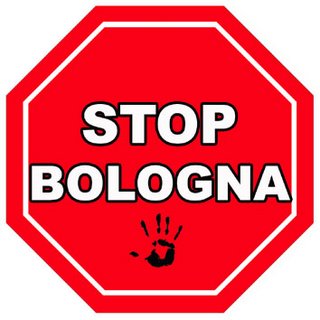 ACABRA.NET - Jornal Universitário de Coimbra: Parar Bolonha
"Este espaço pretende contrariar a propaganda pró-[processo de] Bolonha que diariamente circula nos meios de comunicação social."
quinta-feira, junho 22, 2006
€mpréstimo$ [bancários] para [@s estudantes carenciad@s e remediad@s poderem] €$tudar, eis os resultados... dívidas para uma vida inteira!!!
 É bastante interessante ler-se o artigo «Student Debts, Stunted Lives» da revista "The Nation".
Na senda do argumento neo-liberal do (quase mero) benefício individual de cada indivíduo na formação académica a nível superior, levando a que est@s paguem somas avultadas pela frequência do Ensino Superior [normalmente contraindo extensos empréstimos bancários], vejam-se (no artigo supracitado) os efeitos que tiveram os empréstimos bancários contraídos por várias pessoas [nos E.U.A.] para poderem frequentar o Ensino Superior: dívidas para uma vida inteira!!
quarta-feira, junho 21, 2006
Processo de Bolonha, visto por alguns professores
 Diogo Pires Aurélio (docente de Jornalismo na FCSH-UNL): «por força da aplicação da Declaração de Bolonha, (...) a partir de Setembro próximo, a Universidade tradicional tem os seus dias contados.
[O Processo de] Bolonha é também o triunfo do eduquês e, pior ainda, leva a Universidade a abdicar de tudo quanto foi a sua vocação secular, transformando-a em mais um centro de preparação de "recursos humanos", ao sabor de conjunturas empresariais ou políticas. Se não houver, em paralelo com esta reforma, uma política de estímulo à investigação nos vários domínios, corre-se o risco de ficar com um sistema racionalizado, mas que já pouco terá de Superior e ainda menos de Universitário.»
 João Sousa Andrade (catedrático de Economia na FEUC): «[É "pensamento" corrente que] O importante é ensinar e não dominar um conhecimento científico. Em conformidade, o ensino passou, muitas vezes, a valorizar aspectos lúdicos que afastam o estudante da iniciativa de estudo e do esforço de aprendizagem de uma ciência. (...) No Ensino Superior deparamos com um abandono considerável dos jovens, com taxas de insucesso enormes e uma fraca assiduidade dos estudantes às aulas. E mesmo assim, temos, globalmente, um número de licenciados superior à sua procura. Este desequilíbrio tem empurrado a Universidade a multiplicar os cursos de natureza profissional.
Onde pretendemos chegar? Na Universidade, o passo está dado para confundirmos o ensino científico com o ensino que cria profissionais. A dialéctica do "saber" (ou "conhecimento") e do "fazer" não pode ser encarada em geral, e não pode ser encarada da mesma forma na Universidade e no Ensino Superior Politécnico.
Quais as ideias-base da "revolução" [do Processo] de Bolonha? Para além dos objectivos de um Ensino Superior Universitário Europeu de qualidade, pretende-se fazer uma "revolução" de práticas pedagógicas e de aprendizagem. Que "revolução"? Em que consiste? Será que posso discutir currículos sem discutir no que consistem aquelas novas práticas? Claro que penso na aplicação das "novas ideias", por forma a melhorar o nosso ensino e a resolver os nossos actuais problemas. Não estou assim a admitir a solução adoptada noutros países, que foi de simples adequação. Porque se a questão é de adequação, depressa nos adaptamos ao "figurino" de Bolonha, e não vale a pena perder muito tempo com o assunto.
Penso que existem motivos de preocupação. A ideia que tenho visto nalgumas propostas, de redução de aulas, parece-me abusiva e perigosa. Significa isto que as horas de contacto estarão reduzidas ao "contacto directo"? E o "contacto de apoio"? E a "tutoria"? Quais as novas metodologias de aprendizagem e de estudo que vamos introduzir em proveito do estudante que tornam essas propostas adequadas? As nossas bibliotecas, frequentemente com três ou quatro exemplares de livros usados por várias centenas de estudantes, e com espaços de leitura exíguos, estão adequadas a uma maior iniciativa de estudo e investigação dos estudantes?
A ausência de assiduidade dos estudantes pode ser agravada com uma simples adaptação ao dito "figurino". Como poderemos combater os nossos problemas com as novas reformas? Os métodos pedagógicos e as práticas de aprendizagem nos primeiros semestres não deverão ser diferentes dos últimos semestres. Mas como?
Quanto à questão da dialéctica do "saber" e do "fazer", ou do "conhecimento" e da "formação profissional", os objectivos e os instrumentos adequados ao que entendemos ser uma licenciatura estão em documentos de auto-avaliação. Trata-se de aplicar esses princípios.
O que não é fácil em face do desvio para a formação profissional e da exigência posta na lei sobre o que deve ser uma licenciatura. Mas não se trata de inventar de novo, o que seria mais complicado.
Desde há vários anos que o ensino das licenciaturas tem convergido na Europa. (...) Para essa convergência muito contribuiu a mobilidade de estudantes e docentes. Impor prazos, antecipando [a total aplicação do Processo de Bolonha até] 2010, para uma convergência completa não faz sentido. Impor prazos que podem arrastar e, pior que isso, justificar a simples adequação pode ter efeitos catastróficos.
A regra mais útil a respeitar deveria ser a de que nenhum curso adopta o "figurino" de Bolonha se não alterar a forma de ensinar e aprender. A regra deveria ser a inversa da que impõe prazos para a "reforma".»
terça-feira, junho 20, 2006
Opiniões(?) do ENDA sobre o Processo de Bolonha
Realizou-se no passado fim-de-semana, em Coimbra, um ENDA (Encontro Nacional de Direcções Associativas).
O presidente da Associação Académica de Coimbra [DG/AAC], Fernando Gonçalves, considerou que o ENDA só deve reunir quando "há causas conjuntas" e não apenas "reunir, por reunir".
O líder estudantil de Coimbra concorda que, na verdade, "[actualmente] não há unidade no movimento associativo estudantil". É um pouco "cada um para seu lado", o que lamenta, pois "é negativo" para os interesses dos estudantes, sobretudo, quando algumas associações, como a Associação Académica de Coimbra, estão empenhadas na contestação ao Processo de Bolonha.
Fernando Gonçalves acredita que "estudantes, funcionários e dirigentes estudantis" desconhecem o teor da Declaração de Bolonha, que vai mexer com os cursos do Ensino Superior em Portugal, pelo que pensa que é necessária uma campanha de informação nesse sentido.
Sendo uma decisão europeia, a provável internacionalização da luta anti-[Processo de] Bolonha era um dos pontos em discussão na reunião do ENDA, ontem [sábado] à noite.
No domingo, no ENDA ainda se discutiu (des)emprego, estágios e acção social.
Saliente-se o texto da AAC sobre o Processo de Bolonha e a moção (aprovada) que requer a fiscalização [junto do Provedor de Justiça] da constitucionalidade de vários produtos legislativos correlativos à implementação do Processo de Bolonha em Portugal (proposta pela Federação Nacional de Estudantes de Direito).
[Sobre este ENDA confiram-se outras várias notícias d' A Cabra.net.]
segunda-feira, junho 19, 2006
Editorial de João Morgado Fernandes, no DN
"A Universidade, enquanto pólo de aquisição e construção do saber, morreu. Hoje, pede-se-lhe que seja, em primeira linha, um centro de formação profissional.
(...)
Foi com esse espírito que o chamado Processo de Bolonha encurtou as licenciaturas para três anos. É também à luz dessa eficácia que o Governo português se prepara para exigir a divulgação dos índices de empregabilidade.
(...)
No entanto, a Universidade, se bem que não possa alhear-se do mundo competitivo em que vivemos, não pode igualmente cair no mercantilismo puro.
Quantas vezes um nicho de maluquinhos que se dedicavam a coisas bizarras não deu origem a grandes negócios? Não aconteceu assim, por exemplo, com as novas tecnologias? Não há certas áreas de investigação, nas ciências, por exemplo, condenadas a ser eternamente minoritárias, mas das quais saem profissionais indispensáveis aos progressos da Humanidade?
A excelência pode passar pela massificação, pela elevação do patamar educativo de grandes faixas da população. Mas deve também incluir o direito à diversidade, à aposta naquilo que, sendo inovador, ainda nem sequer tem lugar no mercado de trabalho.
É desejável que, com tanta eficácia, não se esqueça esse papel fundamental da Universidade."
(...)
Foi com esse espírito que o chamado Processo de Bolonha encurtou as licenciaturas para três anos. É também à luz dessa eficácia que o Governo português se prepara para exigir a divulgação dos índices de empregabilidade.
(...)
No entanto, a Universidade, se bem que não possa alhear-se do mundo competitivo em que vivemos, não pode igualmente cair no mercantilismo puro.
Quantas vezes um nicho de maluquinhos que se dedicavam a coisas bizarras não deu origem a grandes negócios? Não aconteceu assim, por exemplo, com as novas tecnologias? Não há certas áreas de investigação, nas ciências, por exemplo, condenadas a ser eternamente minoritárias, mas das quais saem profissionais indispensáveis aos progressos da Humanidade?
A excelência pode passar pela massificação, pela elevação do patamar educativo de grandes faixas da população. Mas deve também incluir o direito à diversidade, à aposta naquilo que, sendo inovador, ainda nem sequer tem lugar no mercado de trabalho.
É desejável que, com tanta eficácia, não se esqueça esse papel fundamental da Universidade."
Opinião Neo-Liberal para o Ensino Superior
Na edição desta semana do "Expresso" vêem dois artigos de opinião (no mínimo) "suculentos":
 «Quem lidera as Universidades?: Acabar com o actual sistema de eleição de reitores de Universidades ou directores de Faculdades seria um bom primeiro passo», escrito por Pedro Oliveira [defende, basicamente, que em Portugal ("à boleia do processo de Bolonha") se aplique uma empresarialização da gestão universitária, assim reformando o sistema de Ensino Superior];
e «Abaixo o ensino gratuito: Precisamos de um choque educativo mas entre subsidiar e ser gratuito vai uma grande distância», da autoria de Luís Cabral [em que afirma "concordar que «todos têm direito à educação» (Constituição da República Portuguesa, artigo 73º, nº 1). Mas porquê o direito à educação gratuita?", pois "muitas das «conquistas irreversíveis» da Constituição de 1975 foram efectivamente revertidas. Por que não esta?" do "pagamento de propinas, um pequeno problema reside no artigo 74º, nº 2, da Constituição: «Incumbe ao Estado (...) assegurar o ensino básico universal, obrigatório e gratuito»", acabando o texto de forma absolutamente lapidar: "Abaixo a educação gratuita. Vivam as propinas."].
«Quem lidera as Universidades?: Acabar com o actual sistema de eleição de reitores de Universidades ou directores de Faculdades seria um bom primeiro passo», escrito por Pedro Oliveira [defende, basicamente, que em Portugal ("à boleia do processo de Bolonha") se aplique uma empresarialização da gestão universitária, assim reformando o sistema de Ensino Superior];e
«Abaixo o ensino gratuito: Precisamos de um choque educativo mas entre subsidiar e ser gratuito vai uma grande distância», da autoria de Luís Cabral [em que afirma "concordar que «todos têm direito à educação» (Constituição da República Portuguesa, artigo 73º, nº 1). Mas porquê o direito à educação gratuita?", pois "muitas das «conquistas irreversíveis» da Constituição de 1975 foram efectivamente revertidas. Por que não esta?" do "pagamento de propinas, um pequeno problema reside no artigo 74º, nº 2, da Constituição: «Incumbe ao Estado (...) assegurar o ensino básico universal, obrigatório e gratuito»", acabando o texto de forma absolutamente lapidar: "Abaixo a educação gratuita. Vivam as propinas."].
Universidades serão obrigadas a revelar a taxa de empregabilidade d@s seus/suas antig@s alun@s
A partir do próximo concurso de acesso ao Ensino Superior, as Universidades portuguesas serão obrigadas a revelar a taxa de empregabilidade d@s alun@s que saíram dos seus cursos, bem como a divulgar as colocações dess@s antig@s alun@s; também haverá novas restrições ao regime de acesso especial ao Ensino Superior, acabando-se com "aqueles que são fonte de injustiça", como sejam (entre outros) os casos de funcionári@s em missão diplomática no estrangeiro e @s familiares, oficiais do quadro das Forças Armadas e atletas de alta competição [no DN, no Público, no Correio da Manhã e no JN].
domingo, junho 18, 2006
Greek Students Movement: Some Background Info on the Struggle in the Universities of Greece
 Certain clauses in the Greek Constitution (stating, among others, that education has to be public and free for all and that no police forces are allowed to enter university grounds) have made the enforcement of a neo-liberal agenda to the country's higher education institutions particularly difficult.
However, the [Greek] Conservative Government is now attempting to push forward crucial changes in the functioning and role of the country's Higher Education institutions. A so-called "committee of experts", appointed by the government itself, has released a list of proposed changes, which include:
- De-registration of students after (X times 1,5) years, where X is the minimum number of years required for completion of their course (now unlimited);
- Limiting the number of times allowed to sit for a module to four (now unlimited);
- Allowing for easier police access to university grounds, the long-term aim being the complete erasure of campus sanction (to date, police are not allowed to enter university property unless specifically instructed to do so by the university's "asylum committee", with the latter's decision-making process being rather complex);
- To end the free distribution of academic books to students (since the Constitution states education has to be free for all, [to date,] universities have to provide required readings to their students free of charge);
- To end student transfers (to date, students meeting certain economic, social and/or health criteria can apply for a transfer to the academic department closest to their area of residence);
- To introduce managerial positions in the universities (to date, all administrative decisions fall under the juridistiction of academic staff).
The above have been incorporated into a law proposal which, according to media reports, will be brought forward by the government and the Education Ministry in July. Another crucial point of the proposed law includes the editing of Article 16 of the Constitution (currently stating that all education should be public and free for all) in order to allow for the foundation of Private Universities in the country.
x.x.x.x.x.x.x.x.x.x.x.x.x.x.x.x.x.x.x.x.x.x..x.x.x.x.x.x.x.x.x.x.x
During the last 3 weeks there is quite some unrest in Greek universities. At the moment more than 180 university departments are occupied by the students. On Thursday 25/5 8.000 students demonstrated in a big protest march in the center of Athens. This unrest is triggered by the reform of higher education proposed by the Ministry of Education.
The proposed reform of Greek higher education has 3 pillars:
1. The change in the legislation that regulates university education. This change serves the purpose of transforming the universities into profit-making institutions. The reformed universities will also be more authoritarian for students. According to the proposed changes every student will have the right to fail only up to 2 times in every course and to finish his studies within n+2 years of studying (until now it's unrestricted). Managing directors and financial managers will take over the administration of universities. Free supplying of compulsory course books will be abolished, social assistance to poor students will be cut down and the students participation in the representative boards of the university will be restricted. A major consequence of this will be that young people from the low-income class will be practically excluded from university education. Moreover, the institution of "University Asylum" (the institution that establishes the right of unrestricted expression and exchange of political views and actions within the borders of the university campuses, including the restriction of police access to the Universities) will be practically abolished.
2. The revision of article 16 of the Greek Constitution that establishes the right of every citizen for free, public education. Therefore, private commercial universities will be established and private vocational training institutions will be officially recognized by the state.
3. The revitalization of previous legislation regarding ICTS and university evaluation credits in order to introduce the model of "life-learning". The introduction of ICTS as well as the recognition of the 3-year bachelors from abroad will abolish the universal character of university degrees (and the relevant universal employment qualifications). In this way, every graduate will have his own "individualized" degree without any negotiable power in the labour market.
To give you an idea of the current situation in Greek higher education: the entry into Universities is done by nation-wide exams in 8 common compulsory subjects (and for some departments in a few choice subjects). There are no time or exam restrictions in studying. Study programs last 4 or 5 years. Students are allowed to pass their courses in whatever year they want and to study for as many years as they want. In practice, however, it's not their fault when they delay to graduate as failure rates in many exams can reach 80%. Higher education is free of charge. Students pay no study fees and they enjoy free supply of compulsory course books. Again, in practice the situation is different. As Greek students get no kind of "studiefinanciering" they have to finance themselves housing and living expenses (that have particularly increased the last years) as well as supplementary course material (as the free course books are usually of low quality in many cases). There is no such thing as ICTS or study credits; students have just to pass a number of compulsory and choice courses. Degrees are "universally equivalent" in the sense that every graduate gets a degree in Mathematics/Medicine/Language, etc, with his general grade on it. Nothing more is mentioned on the degree and nothing more is valid in the labour market. Officially, all graduates from the same department have the same qualifications for the labour market, which is quite rigid. In practice, however, the unemployment rates are very high and young people have many difficulties in finding even a badly paid job. Moreover, in Greece there are hardly any high-paid jobs.
Many governments have attempted to reform the educational system by incorporating the EU directives. All attempts have failed due to the strong opposition of the students movement. Occupations of Universities and huge demonstrations cancelled all government political efforts to reform higher education in 1991, 1992, 1995, 1998 and 2001. In the Greek Universities, there is a long tradition of the students movement. Though less than in the 70s and 80s, a large number of students is interested in politics. There are organized students elections every year and the participation rates reach 70-80%. There is one students union in every department and assemblies are held a few times every year. Thus, a picture of hundreds of students in a hall debating on local and political issues is not uncommon for Greece. Occupations of universities and protest marches of thousands of students are the most usual actions for the students movement. Furthermore, since the early 90s the horizontal organizing of the movement has become rather dominant. Despite the fact the groups and organizations of the radical left are powerful in the movement, the assemblies and the open coordination meetings "calls the shots" in the movement. And these groups and organizations of the radical left have strongly supported this development and they take credit for it.
This month, the government launched a campaign in order to promote the reform in higher education. Thus, specialized committees of "independent experts" published reports about the need for a reform in higher education. These reports, all of a sudden, coincide remarkably with the ideas of the Ministry of Education. As a reaction to this, student assemblies in most of the universities were called and occupations of most of the Greek universities were decided. The protest march of last Thursday was the second big students demonstration in Athens. During the first one, about 10 days ago, clashes between the demonstrators and the riot police broke out. Further demos took place in several other Greek cities. After the last protest march about 1.000 students from all over the country met in a plenary coordination meeting in Athens and called for a continuation of the actions against the government policy.
Contrary to the way the official workers trade unions handle the movement, the students do not get into any kind of bargaining or negotiations with the ministry of education. They demand the full withdrawal of all governmental proposals for higher education. They demand free public education for all young people. They also demand the government to secure the universal character of the degrees and take action to reduce unemployment for young people.
It is important to stress that both the conservative government (party of "New Democracy") and the opposition party of the social-democrats (PASOK) support the proposed reforms. The actions of the students are not even supported by the Communist Party, which gets around 14% in the students elections. The Communist Party is in favor of less radical actions (it's against occupations of universities and calls separate demos from the rest of the students). Politically-wise the driving force of the movement is the grass-roots radical left groups (EAAK). However, there is such unrest among the students that even in departments where there is no radical left group (or it exists but it's powerless) the student assemblies vote in favor of the actions against the government.
x.x.x.x.x.x.x.x.x.x.x.x.x.x.x.x.x.x.x.x.x.x..x.x.x.x.x.x.x.x.x.x
LA SOLIDARITÉ EST NOTRE ARME!
sábado, junho 17, 2006
«Modelo de Bolonha acaba com tunas académicas»
 Fabricantes de emblemas bordados, trajes académicos, pins, bandolins, cavaquinhos, o grupo musical Placebo e Quim Barreiros estão desesperados. O novo modelo das Universidades não proíbe as tunas, mas anuncia prerrogativas que implicam o seu fim. O Processo de Bolonha pretende a promoção da mobilidade dos estudantes. O excesso de álcool, os instrumentos musicais e trajes volumosos são um grande obstáculo à mobilidade pretendida. O Modelo de Bolonha continua o seu ataque ao espírito das tunas com a ideia da promoção da aprendizagem ao longo da vida, aumento da empregabilidade dos diplomados, criar condições para o gosto pelo saber e pelo conhecimento, redução das taxas de abandono e possibilidade de conclusão dos cursos ou estudos em tempo razoável.
texto da autoria de JH, in "O Inimigo Público", nº 143, de 16 de Junho de 2006, jornal satírico suplemento do "Público".
sexta-feira, junho 16, 2006
Actividades do movimento estudantil na Alemanha
Salut les amis!
Ici c'est Dirk, je fais parti du mouvement des étudiants contre les frais d'études en Allemagne et de un des plus grands portailes d'info sur la politique d'éducation en Allemagne.
En ce moment nous luttons contre les frais d'études qui seront installés dès l'année 2007. Chaque étudiant doit payer 1000 euro l'année plus frais d'administration. Les étrangers pas venant de UE payent 3000 euro l'année sans avoir droit au credit ce qu'il est raciste selon nous.
J'ai quelque chose de concret à vous proposer: venez chez nous et manifester avec nous! Ici, dans l'état de Hessen (en Allemagne) le mouvement contre les frais d'études existe depuis 4-5 semaines et est à comparer avec la situation en France en Mars.
Comme le système est federal en Allemagne, c'est pas encore une mouvement partout, mais ça commence petit à petit. Le signe du mouvement ici en Allemagne est le drapeau français, afin de monter que nous, on est aussi decidé. A chaque manif il y a ces drapeaux et sa nous mont vraiment la morale.
Lors d'une assemblée générale de la faculté de Francfort, nous avons donc eu l'idée d'amener beaucoup des français en Allemagne afin de manifester ensemble. Celá peut nous motiver. De plus vous pouvez manifester pour vos idées et on a un nouveau moyens de protest: les français ensemble avec les allemands. Quelle signe!
Nous, on a déjà travaillé dessus. Il y a pleins des allemands qui en revent et qui proposent des places à dormir et tout. On a peut-être même la chance de recuperer l'argent des syndicats pour payer les cars.
Il y a déjà une date: le 6 Juillet. C'est très court et chaud à cause des vacances, mais déjà quelque bus seraient cool. Sinon on peut le faire en Septembre, après la rentrée mais c'est maintenant ou c'est chaud. Bientôt il y aura un campus camping à Francfort. S'il y a des gens interessés à venir ça serait cool aussi. Squatter dans un ambiance tranquille à Francfort pendant le Coup du Monde et faire des actions au même temps peut-être interessant et motivant. Tout le monde est invité.
Croyez vous, qu'il est faisable à realiser ce projet? Pouvez-vous transmettre ces infos parmi votre réseau? Si on arrive bouger les gens de Strasbourg, Lille, Reims, Paris, Metz c'est faisable selon moi, parce que c'est pas trop loin. Il faut juste des gens qui m'aident organiser.
De plus, pouvez vous envoyez des déclarations de solidarité pour nos actions [enfin, seulement si vous êtes solidaires :-) ] En les publiera et ça será motivant pour nous.
Si vous avez besoin de plus des infos sur ce qu'il se passe ici, contactez moi.
Merci,
Dirk Vollger.
quinta-feira, junho 15, 2006
Em Junho por todo o país: Debates sobre Educação
O Conselho Nacional de Educação realiza (em Junho e pelo país inteiro) uma série de debates sob a temática "Como melhorar a Educação nos próximos anos?", sendo que em Coimbra será no dia 22, na área temática 5 intitulada "Ciência, Investigação e Desenvolvimento Educativo" [mas pode-se conferir os debates em outros locais].
Coimbra, a 22 de Junho de 2006:
Debate sobre Ciência, Investigação e Desenvolvimento Educativo
Local: Auditório da Reitoria da Universidade de Coimbra
14h30 - Abertura
António Morão Dias - Director Geral do Ensino Superior
João Sentieiro - Presidente da Fundação para a Ciência e Tecnologia (a confirmar)
Fernando Seabra Santos - Reitor da Universidade de Coimbra.
15h00 - Painel I: Investigação Científica e Desenvolvimento
«Que modelos de produção científica teremos de solidificar e de criar de novo para sustentar o desenvolvimento de uma economia baseada no conhecimento?»
Cristina Robalo Cordeiro - Vice-Reitora da Universidade de Coimbra
Arsélio Pato de Carvalho - CNE e Universidade de Coimbra
Moderador: Domingos Xavier Viegas - CNE.
16h30 - Painel II: Gestão do Ensino Superior para o Desenvolvimento
«Que novos modelos adoptar para a gestão da qualidade no ensino superior e que refenciais devem orientar a construção da excelência?»
José Tribolet - IST, Presidente do INESC
Vitor Santos - Presidente do ISEP
Moderador: António Dias Figueiredo - CNE.
Relator da sessão: Ivo Costa Santos - CNE.
[Ambos os painéis terão espaço de debate com o público após as alocuções dos palestrantes.]
quarta-feira, junho 14, 2006
Como vai o Processo de Bolonha, em França...
Como anda (em França) o processo de Bolonha - Rádio Renascença: Lá, como cá, as Universidades reclamam mais verbas para pôr em prática todas as alterações necessárias à construção de um Espaço Europeu de Ensino Superior.
Processo de Bolonha está aí... a todo o vapor!!!
Para quem ainda possa (distraidamente) não ter reparado: o processo de Bolonha está (de mansinho) a ser implementado em Portugal a grande velocidade, nomeadamente através da (algo apressada) adequação à nova estrutura de graus e ciclos de estudos do Ensino Superior [confira-se na Direcção Geral do Ensino Superior].
Relembre-se que as novas designações de alguns cursos já haviam gerado algumas críticas aos reitores [DN e documento "Bolonha, desvario no Ensino Superior"].
Relembre-se que as novas designações de alguns cursos já haviam gerado algumas críticas aos reitores [DN e documento "Bolonha, desvario no Ensino Superior"].
terça-feira, junho 13, 2006
Grécia: Vitória da Educação Pública e para Tod@s!!!
As notícias que nos chegam de Atenas são tremendamente positivas: o Ministro da Educação grego anunciou que o Governo vai retirar a proposta de lei contra a qual @s estudantes e professor@s greg@s se manifestaram em massa nas ruas e na ocupação dos departamentos universitários!!
Esta é uma primeira grande vitória do movimento estudantil grego (que soube alargar-se a professor@s [não só universitári@s] nesta luta/frente comum)!!!
Abaixo segue mais um relato dos acontecimentos por parte do nosso camarada Yiannis e deixam-se algumas outras ligações [para uma notícia da manifestação da semana passada, nomeadamente a atroz violência policial que pode ser vista em algumas fotografias; e uma outra notícia]:
The facts today (13.June.2006)
397 university departments are now occupied all over the country. The National Federation of University Professors is on a permanent strike and form a common front with the students movement.
Last Thursday (the last national demo in Athens, of approximately 25.000 participants) the Federations of Teachers of Primary (DOE) and Secondary (OLME) education organized a 3-hour strike, in order to participate in the demo.
The rumour today in many major media (including even centre-right press) is that the Government is thinking seriously of withdrawing the law proposal for October. Today and in the next two days there is a new round of General Assemblies in Schools, in order to decide the continuation of the occupations and other actions of resistance and press the government more.
THE BASIC DEMANDS OF THE GREEK STUDENT MOVEMENT, AS THEY HAVE BEEN FORMED BY THE NATIONAL CO-ORDINATION ASSEMBLY OF OCCUPATIONS, ARE:
- Immediate withdrawal of the Law Proposal for the reform of the Legal Framework, that defines the foundation, the principles and the function of higher education in Greece.
- No reform of Article 16 of the Greek Constitution, which forbids the foundation of private universities and defines that public and free education is a right of all people and it is an obligation of the State to provide it.
- Withdrawal of the new laws (that were voted last year) about the initiation of a marketized "evaluation" of universities by external actors of the market and the industry owners, the introduction of managers in every school and the initiation of a sponsored, super-specialized, "life long learning", which will demolish the value of degrees and dismantle the curricula of schools into a personalized addition of credits, without any professional rights.
- Guaranteed professional rights for every student that gets his/her degree.
- Free transfers, accomodation and food for all students.
THE GREEK MINISTER OF EDUCATION JUST ANNOUNCED THAT THE GOVERNMENT WITHDRAWS THE NEW LAW PROPOSAL FOR OCTOBER!!!!!
THE FIRST BIG VICTORY OF THE GREEK STUDENTS MOVEMENT IS A REALITY! WE ARE MORE MASSIVE THAN EVER! THIS MOVEMENT IS LIKE THE FLOWERS THAT BLOSSOM EVERY DAY!
WE CONTINUE: NEW DEMONSTRATION IN ATHENS THIS THURSDAY!
text emailed by Yiannis Bournous.
domingo, junho 11, 2006
Para reflexão: «The New Face of the Campus Left»
Deixo aqui as ligações para um algo extenso e bastante interessante artigo [com 1, 2, 3, 4, 5 páginas] de Sam Graham-Felsen, publicado na edição de Fevereiro da revista norte-americana "The Nation", em que se realiza uma análise aos "movimentos estudantis à esquerda" nas Universidades dos Estados Unidos da América em pleno século XXI, sendo que (no final desse texto e em tom de conselho) nos diz Todd Gitlin, antigo presidente da Students for a Democratic Society:
"The primary goal is not some sort of symbolic display, or some sort of posture or attitude, but results. If that's what it means, then I applaud the turn to practicality. Today the far right is in charge, and I don't think you can create the possibility of broad-based radicalism until you defeat the far right. Put the center in power and then you have the possibility - or the luxury - of radicalism."Posteriormente, houve espaço para o contraditório com alguns/mas representantes dos movimentos estudantis visados no artigo de Sam Graham-Felsen.
Acabar-se com o Conselho de Reitores??
 Marçal Grilo (ex-ministro da Educação) defende [entre outras coisas] o fim do Conselho de Reitores [no jornal «Público», secção Sociedade, sexta-feira dia 9 de Junho].
sábado, junho 10, 2006
A luta (mais que) estudantil que presentemente acontece na Grécia: «They [the Governing] make laws, we [the People] make History!!!»
Brothers and sisters in struggle,
the Greek Student Movement is reaching its highest moment: 346 departments are right now occupied and yesterday the national demo in Athens gathered 25.000 students, coming from every corner of the country.
The Federation of University Professors (POSDEP) is on a permanent strike and also now we have the Federations of Primary (DOE) and Secondary (OLME) Education Teachers with us! Yesterday these two Federations went on a 3-hour strike in order to participate in our national demonstration. Moreover, everyday we receive messages of solidarity from trade unions and Federations of all sectors.
Nevertheless, the neoliberal right-wing Government decided to show its teeth: they announced that the new laws will be brought in the Parliament in the Summer Session (probably in August) and they accuse us of being "a minority who wishes to destroy our Universities".
Yesterday at the demo we experienced the HARDEST repression I have ever seen in the last 8 years that I am politically active. In front of the Ministry of Education and in front of the Parliament some groups clashed with the Special Forces and, from that point, the Police began a blind attack against all blocks, which were full of 18 and 19-year old students, most of which participate in the movement for the first time in their life.
They turned the city centre into a gas chamber and even threw "panic bombs" (bombs that make a huge sound when they explode, in order to terrify the demonstrators). They even threw stones(!) against the blocks and, in one point, managed to brake the human chains we made, circle two blocks of unprotected students and suffocate them in tear gas, hit them on their face and body with globs and with their shields and arrest many of them.
The demo managed to march ahead and kick out many of the people that were trying to cause trouble, by braking stores and throwing molotv bombs (I will not even call them anarchists...).
Over 10.000 people reached and entered the occupied Polytechnic School, in order to be protected. We stayed in the School for at least four hours, guarding the doors and trying pushing the Black Block to clash with the Police outside the University. The Special Forces surrounded the School and started throwing tear gas bombs in the School, in order to suffocate us. We were medically well prepared and managed to help all people who faced breath problems.
Finally, after negotiations of Alekos Alavanos (the President of our Party) and the Federation of professors with the Minister of Public Order, the Police withdrew its forces and we left the Polytecnhic in a common big block, singing songs of freedom and slogans.
The Movement now demands not only the withdrawal of the new law, but also the resignation of the Ministers of Education and Public Order, as the main political responsible for what happened yesterday. This demand has been also expressed by the professors and Synaspismos: 42 people arrested, over 150 badly injured. Yesterday it was another day of disgrace for democracy and human dignity.
Nevertheless, it was one of those small moments in your life, when you realize that you make your duty towards yourself, the society and History. If one month ago all this could be a dream, today it's an unrefused reality.
Next Thursday we shall flood the streets again.
More decisive, more massive, more proud than ever before.
They make laws, We make History.
We continue. We shall win.
text emailed by Yiannis Bournous.
[Para além da ligação já disponibilizada (do IndyMedia grego, contendo bastante informação) no título deste texto, podem ainda consultar-se mais informações noutros centros IndyMedia (por exemplo: no geral e no britânico) e seguir-se o (incrível) mapa de ocupações de Departamentos Universitários na Grécia (presentemente já são 374, ultrapassando os 346 referidos pelo Yannis no seu texto).]
sexta-feira, junho 09, 2006
A posição dos Reitores sobre o "congelamento" das vagas de acesso ao Superior e o não financiamento Estatal a licenciaturas com menos de 20 alunos...
Há notícias algo contraditórias quanto à opinião/posição dos Reitores das Universidades no que toca ao "congelamento" do número de vagas disponíveis para o concurso nacional de acesso ao Ensino Superior Público [conferir no DN e no Público], mas (principalmente) os Reitores das Universidades e os Presidentes dos Politécnicos pedem que não haja uma "redução tão brusca" de 20 para 10 alunos matriculados, como patamar mínimo para o financiamento público das licenciaturas, mas que se reduza apenas para 15 alunos.
The Boycott of Palestinian Education: Can the Anti-Boycotters [all over the World] Please Stand Up??!!!
By: Right to Education Campaign, Birzeit University (Palestine)
In the flurry of letters and comments against the boycott of Israeli academics who, according to Natfhe, are complicit through their work or silence, in the military occupation of the West Bank and Gaza, the reality facing the other side of the coin, that of Palestinian academics, researchers and educational institutions, has been ignored. The crux of the anti-boycott but pro-peace argument is that Academia is one of the few places where constructive argument is possible, and Israeli academic freedom is the cornerstone for the push for change in Israeli policy and ultimately, for the end of military occupation in the Palestinian territories.
The circle this argument fails to close is that without the freedom of Palestinian Education the prospect of any genuine dialogue on the long-term solution to the conflict cannot materialise. And in the absence of a sizeable and meaningful denunciation of Israeli clampdowns on Palestinian Education, what other mechanisms are there to awaken the pro-dialogue, pro-peace camp?
Under Israeli occupation, all eleven Palestinian universities have been closed, the longest being Birzeit between 1988 and 1992, and the most recent Hebron Polytechnic which was closed by military order for 8 months in 2003. During these periods community-based classes were criminalized and its teachers and students arrested. Since 2000, 185 schools have been shelled and scores of teachers and students have been shot at and arrested. Then there are the less extreme but just as effective obstacles like the 700 restrictions of movement by checkpoints, road-blocks and earth mounds. Through creating and controlling a system of internal borders in the occupied territories, the Israeli military prevents students from accessing Palestinian Universities far from their homes. University campuses are then increasingly ghettoised; Birzeit [University] now attracts the vast majority of its new students from the Ramallah and Jerusalem areas, and its intake of people from Jenin has dropped by 100%. This also means students are limited in their course choices; 12 students from Gaza have been denied permission to go to Bethlehem [University] and study Occupational Therapy (a course not available in Gaza) despite them not representing a security threat to Israel - a point the military admitted at the Israeli High Court where the decision is currently being challenged.
However, the latest round of Israeli attacks on Palestinian Education has been through the control of its external borders. As an occupying power, Israel is legally responsible for guaranteeing all human necessities and rights in the occupied territories, including the right to Education, and is in de facto control of all that goes in and out of the territories, including foreign academics, researchers and students.
Those wishing to study or work in Palestinian Universities have to go through farcical procedures that are bad at the best of times. Students are often denied entry if they reveal they will be based inside the occupied territories. This is so common that Palestinian Universities even advise students to claim they will be tourists in Tel Aviv instead. While other countries foreign students are given visas for the duration of their courses, in the occupied territories they suffer the stress of insecurity and the burden of having to lie - itself in breach of their universal right of access to Education. The overall message here is clear: if you want to study, you cannot do it in Palestine.
Only in March this year, two students from the internationally well-reputed Birzeit University in the West Bank were interrogated, humiliated and deported, without being given any explanation. The European female student was called a prostitute for having had a relationship with a Palestinian man, accused of having separatist tendencies for coming from a German-speaking minority in northern Italy, and asked why she didn't study Hebrew instead of Arabic. The American student received even worse treatment. He was strip searched, yelled at, called an "arsehole", had his face photographed as if he were a criminal, and when it transpired he was half-Arab the interrogator responded "what a pity, what a pity".
University Faculty members and staff with foreign passports undergo similar ordeals. Most have to leave the country every three months just like the foreign students despite having built their professional and family lives in the West Bank. They have no guarantees they will be able to stay from one visa application to the next. A few lucky ones are given 6-months visas from the Israeli military administration in the settlement of Bet El, but despite being allowed to make in-country applications, they still have no guarantees the application will be successful. If the pro-peace camp is serious about the sanctity of academic freedom, one of first things they should be actively protecting is the access of academic staff and students to Palestinian Universities, especially if they are also serious about wanting a partner for dialogue.
In March 2006, two Faculty members of Birzeit University have had their visa renewals rejected, one of which has been deported. After being shouted at and humiliated by young soldiers, the Faculty members were told they had abused the visa system - despite having never overstayed - and were denied re-entry. Both had been legally living in the West Bank since the 1990s and neither was given any explanation for why they had suddenly become a threat to Israel.
As arbitrary and outrageous as it already seems, the repression of Palestinian Education casts its net even wider. In February 2006, a research student linked to a prestigious British University was detained for 8 hours, asked to become an informant for Israeli services and denied a visa for his PhD research. In April 2006, the well-known assistant professor at Columbia University in New York, Joseph Massad, was refused entry to attend a conference at a University in the West Bank. In May 2006, the British human rights lawyer, Kate Maynard, was refused entry to attend a legal conference in Jerusalem, and less than one week ago, a volunteer with the Ramallah-based human rights research office Al-Haq, was deported.
The systematic obstruction of Palestinian Education not only violates the human rights of the individuals involved, but is also an attack on the development of Palestinian society as a whole. It should also be stressed that none of the people mentioned here were given any legal justification for their visa refusals, and given the carte blanche status of the 'security' argument in Israel, and anywhere in the world, it is clear that had their activities posed a genuine threat to the state of Israel (however tenuous the link) they would have been arrested and charged, even if later deported. None of them were.
It is increasingly apparent that any academic activity - be it research, debate or voluntary work - on the mere subject of Palestine, in Palestine, is either obstructed or forbidden. So while Israeli academics and political figures are busy mobilizing their supporters worldwide to protect the academic freedom of their intellectuals and institutions, other academics, researchers and students exercising their academic freedom in Palestine, are effectively being boycotted. The objective of this boycott is to thwart the advancement of Palestinian educational institutions, networks and discourse, and although any nationality can be subjected to it, its target is in fact the constitution of Palestinian Education itself.
If the asymmetries of the facts on the ground are not enough to justify the boycott of Israeli Academia, then at the very least the limitations and pretence of the pro-dialogue argument must be realised. If there is no boycott of Israeli Academia and current circumstances persist, Israeli academics would turn into the gatekeepers of any debate on Israel-Palestine - for only their freedoms would be secured by the Israeli state. What would be of the pro-dialogue, pro-peace anti-boycotters then? Where would they find their authentic 'partners' to dialogue with? The legitimacy of the fight for Israeli intellectual freedom is in itself dependant on there being the same freedom for Palestinians. Such a basic and fundamental point should be a no-brainer but yet it continues to be conveniently ignored by those claiming to have the most equitable and long-standing interests at heart.
"Education is both a human right in itself and an indispensable means of realizing other human rights" - UNESCO, Committee on implementation of the International Covenant on Economic, Social and Cultural Rights.
"The Separation Wall doesn't only separate the West Bank geographically, it also separates us socially and culturally and we need to resist that through education." - Fourth-year student at Birzeit University, from Qalqilia.
quinta-feira, junho 08, 2006
Posição do PCP face ao processo de Bolonha
 Jornal «Avante!»: "Para o PCP, a implementação deste «processo» [de Bolonha] leva à discriminação económica entre os estudantes.
Aos estudantes com menos poder económico fica reservado o primeiro ciclo, ou seja, «só terão acesso aos conhecimentos técnicos básicos que lhes permitam servir os interesses do grande capital». Os estudantes com maior poder económico poderão passar ao chamado «segundo ciclo» e aceder à «formação integral, à cultura e à ciência», destacaram os comunistas de Aveiro."
Avisos realizados por personalidades académicas
«Diário Económico»: "No debate sobre Educação, Ciência e Tecnologia promovido pelo Conselho Nacional da Educação foram várias as personalidades do mundo académico que fizeram sucessivos "avisos à navegação" quanto à implementação do processo de Bolonha em Portugal".
Em 2006/2007: teremos menos vagas e menor financiamento público para as Universidades
Sabe-se que o Governo irá "congelar" o número de vagas disponibilizadas para o concurso nacional de acesso ao Ensino Superior Público (com as excepções dos cursos de Medicina e Enfermagem) e, também, que o Estado irá deixar de financiar as licenciaturas com menos de 20 alunos [no Público.pt].
Refira-se, curiosamente, o aplauso do Sindicato de Professores (SNESup) ao congelamento das vagas [no Portugal Diário] e o protesto dos Reitores contra o fecho dos cursos que tenham menos de 20 alunos matriculados [no Diário Económico].
Refira-se, curiosamente, o aplauso do Sindicato de Professores (SNESup) ao congelamento das vagas [no Portugal Diário] e o protesto dos Reitores contra o fecho dos cursos que tenham menos de 20 alunos matriculados [no Diário Económico].
No Chile: estudantes do Secundário mobilizam-se por uma Educação Pública e de Qualidade!!!
 Desta luta travada no Chile pel@s estudantes do Secundário (a que também já se agregaram @s professor@s e estudantes universitári@s, constituindo-se num forte movimento em todo o país) podem ler-se notícias várias no IndyMedia, um artigo de opinião no Rebelion e um breve relato num blogue.
quarta-feira, junho 07, 2006
Frente de Acção Estudantil (FAE) apresenta-se...
ACABRA.NET - Jornal Universitário de Coimbra: "O grupo [Frente de Acção Estudantil] acusa a Direcção-Geral da Associação Académica de Coimbra de ter “um discurso dúbio” relativamente ao Processo de Bolonha e ir contra as deliberações de Assembleia Magna."
Link: http://accaoestudantil.blogspot.com/.
Link: http://accaoestudantil.blogspot.com/.

Declaração de Stephen Colbert às/aos nov@s diplomad@s do Knox College (Illinois, EUA)
«Outsourcing is so easy that I had this speech today written by a young man named Panjeeb from Bangalore [University].»
 The following is the full transcript of Stephen Colbert's June 3, 2006, Commencement Address at Knox College in Galesburg, Illinois.
Stephen Colbert [pours water into a glass at the podium, splashes face and back of neck]...
Thank you. Thank you very much. First of all, I'm facing a little bit of a conundrum here. My name is Stephen Colbert, but I actually play someone on television named Stephen Colbert, who looks like me, and who talks like me, but who says things with a straight face he doesn't mean. And I'm not sure which one of us you invited to speak here today. So, with your indulgence, I'm just going to talk, and I'm going to let you figure it out.
I wanted to say something about the Umberto Eco quote that was used earlier from "The Name of the Rose". That book fascinated me because in it these people are killed for trying to get out of this library a book about comedy, Aristotle's commentary on comedy. And what's interesting to me is one of the arguments they have in the book is that comedy is bad because nowhere in the New Testament does it say that Jesus laughed. It says Jesus wept, but never did he laugh.
But, I don't think you actually have to say it for us to imagine Jesus laughing. In the famous episode where there's a storm on the lake, and the fishermen are out there. And they see Jesus on the shore, and Jesus walks across the stormy waters to the boat. And St. Peter thinks, "I can do this. I can do this. He keeps telling us to have faith and we can do anything. I can do this.". So he steps out of the boat and he walks for -- I don't know, it doesn't say -- a few feet, without sinking into the waves. But then he looks down, and he sees how stormy the seas are. He loses his faith and he begins to sink. And Jesus hot-foots it over and pulls him from the waves and says, "Oh you of little faith.". I can't imagine Jesus wasn't suppressing a laugh. How hilarious must it have been to watch Peter -- like Wile E. Coyote -- take three steps on the water and then sink into the waves.
Well it's an honor to be giving your commencement address here today at Knox College. I want to thank Mr. Podesta for asking me two, two and a half years ago, was it? Something like that? We were in Aspen. You know being people who go to Aspen. He asked me if I would give a speech at Knox College, and I think it was the altitude, but I said yes. I'm very glad that I did.
On a beautiful day like this I'm reminded of my own graduation 20 years ago, at Northwestern University. I didn't start there, I finished there. On the graduation day, a beautiful day like this. We're all in our gowns. I go up on the podium to get my leather folder with my diploma in it. And as I get it from the dean, she leans in close to me and she smiles, and she says [train whistle] "that's my ride, actually. I have got to get on that train, I'm sorry.". [Heads off stage.] Evidently that happens a lot here. So, I'm getting my folder, and the dean leans into me, shakes my hand and says, "I'm sorry.". I have no idea what she means. So I go back to my seat and I open it up. And, instead of having a diploma inside, there's a scrap -- a torn scrap of paper -- that has scrawled on it, "See me.". I kid you not.
Evidently I had an incomplete in an independent study that I had failed to complete. And I did not have enough credits. And, let me tell you, when your whole family shows up and you get to have your picture taken with them -- and instead of holding up your diploma, you hold the torn corner of a yellow legal pad -- that is a humbling experience. But eventually, I finished. I got my credits and next year at Christmas time, they have mid-year graduation. And I went there to get my diploma then. They said that I had an overdue library fine and they wouldn't give it to me again. And they eventually mailed it to me I think. I'm pretty sure I graduated from college.
But I guess the question is, why have a two-time commencement loser like me speak to you today? Well, one of the reasons they already mentioned I recovered from that slow start. And I was recently named by «Time» magazine one of the 100 Most Influential People in the World! Yeah! Give it up for me! Basic cable THE WORLD! I guess I have more fans in sub-Saharan Africa than I thought. I'm right here on the cover between Katie Couric and Bono. That's my little picture -- a sexy little sandwich between those two.
But if you do the math, there are 100 Most Influential People in the World. There are 6.5 billion people in the world. That means that today I am here representing 65 million people. That's as big as some countries. What country has about 65 million people? Iran? Iran has 65 million people. So, for all intents and purposes, I'm here representing Iran today. Don't shoot.
But the best reason for me to come to speak at Knox College is that I attended Knox College. This is part of my personal history that you will rarely see reported. Partly because the press doesn't do the proper research. But mostly because it is not true! I just made it up, so this moment would be more poignant for all of us. How great would it be if I could actually come back here -- if I was coming back to my alma mater to be honored like this. I could share with you all my happy memories that I spent here in Galesburg, Illinois. Hanging out at the Seymour Hall, right? Seymour Hall? You know, all of us alumni, we remember being at Seymour Hall, playing those drinking games. We played a drinking game called Lincoln-Douglas. Great game. What you do is, you act out the Lincoln-Douglas debate and any time one of the guys mentions the Dred Scott decision, you have to chug a beer. Well, technically three-fifths of a beer. [groans from audience]
You DO have a good education! I wasn't sure if anybody was going to get that joke.
I soon learned that a frat house -- oops -- divided against itself cannot stand.
How can I forget cheering on the team -- the Knox College Knockers? The Prairie Fire. Seriously, the Prairie Fire. Your team is named after something that can get you federal disaster relief. I assume the "Flash Floods" was taken.
Oh, yes, the memories are so fresh. It was as if it was just yesterday I made them up. And the history, you don't have to tell me the history of Knox College. No, your website is very thorough. The college itself has long been known for its diversity. I am myself a supporter of diversity. I myself have an interracial marriage. I am Irish and my wife is Scottish. But we work it out. And it is fitting, most fitting, that I should speak at Knox College today because it was founded by abolitionists. And I gotta say -- I'm going to go out on the limb here -- I believe slavery was wrong. No, I don't care who that upsets. I just hope the mainstream media give me the credit for the courage it took to say that today. I know the blogosphere is just going to explode tomorrow. But enough about me. If there can be enough about me.
Today is about you -- you who have worked so hard to pack your heads with learning until your skulls are all plump like -- sausage of knowledge. It's an apt metaphor, don't question it. But now your time at college is at an end. Now you are leaving here. And this leads me to a question that just isn't asked enough at commencements. Why are you leaving here?
This seems like a very nice place. They have a lovely website. Besides, have you seen the world outside lately? They are playing for KEEPS out there, folks. My God, I couldn't wait to get here today just so I could take a breather from the real world. I don't know if they told you what's happened while you've matriculated here for the past four years. The world is waiting for you people with a club. Unprecedented changes happening in the last four years. Like globalization. We now live in a hyperconnected, global economic, outsourced society. Now there are positives and minuses here. And a positive is that globalization helps us understand and learn from otherwise foreign cultures. For example, I now know how to ask for a Happy Meal in five different languages. In Paris, I'd like a "Repas Heureux". In Madrid a "Comida Feliz". In Calcutta, a "Kushkana, hold the beef". In Tokyo, a "Happy Seto". And in Berlin, I can order what is perhaps the least happy-sounding Happy Meal, a "Glugzig Malzeiht".
Also globalization, email, cell phones interconnect our nations like never before. It is possible for even the most insulated American to have friends from all over the world. For instance, I recently received an email asking me to help a deposed Nigerian prince who is looking for a business partner to recuperate his fortune. Thanks to the flexibility of global banking, a Swiss bank account is ready and waiting for my share of his money. I know, because I just emailed him my Social Security number.
Unfortunately for you job seekers, corporations searching for a better bottom line have moved many of their operations overseas, whether it's a customer service operator, a power factory foreman, or an American flag manufacturer. They're just as likely to be found in Shanghai as Omaha. In fact, outsourcing is so easy that I had this speech today written by a young man named Panjeeb from Bangalore.
If you don't like the jokes, I assure you they were much funnier in Urdu.
And when you enter the work force, you will find competition from those crossing our all-too-poorest borders. Now I know you're all going to say, "Stephen, Stephen, immigrants built America.". Yes, but here's the thing -- it's built now. I think it was finished in the mid-70s sometime. At this point it's a touch-up and repair job. But thankfully Congress is acting and soon English will be the official language of America. Because if we surrender the national anthem to Spanish, the next thing you know, they'll be translating the Bible. God wrote it in English for a reason! So it could be taught in our public schools.
So we must build walls. A wall obviously across the entire southern border. That's the answer. That may not be enough -- maybe a moat in front of it, or a fire-pit. Maybe a flaming moat, filled with fire-proof crocodiles. And we should probably wall off the northern border as well. Keep those Canadians with their socialized medicine and their skunky beer out. And because immigrants can swim, we'll probably want to wall off the coasts as well. And while we're at it, we need to put up a dome, in case they have catapults. And we'll punch some holes in it so we can breathe. Breathe free. It's time for illegal immigrants to go -- right after they finish building those walls. Yes, yes, I agree with me.
There are so many challenges facing this next generation, and as they said earlier, you are up for these challenges. And I agree, except that I don't think you are. I don't know if you're tough enough to handle this. You are the most coddled generation in history. I belong to the last generation that did not have to be in a car seat. You had to be in car seats. I did not have to wear a helmet when I rode my bike. You do. You have to wear helmets when you go swimming, right? In case you bump your head against the side of the pool. Oh, by the way, I should have said, my speech today may contain some peanut products.
My mother had 11 children: Jimmy, Eddie, Mary, Billy, Morgan, Tommy, Jay, Lou, Paul, Peter, Stephen. You may applaud my mother's womb. Thank you, I'll let her know. She could never protect us the way you all have been protected. She couldn't fit 11 car seats. She would just open the back of her Town & Country -- stack us like cord wood: four this way, four that way. And she put crushed glass in the empty spaces to keep it steady. Then she would roll up all the windows in the winter time and light up a cigarette. When I die I will not need to be embalmed, because as a child my mother hickory-smoked me.
I mean even these ceremonies are too safe. I mean this mortarboard look, it's padded. It's padded everywhere. When I graduated from college, we had the edges sharpened. When we threw ours up in the air, we knew some of us weren't coming home.
But you have one thing that may save you, and that is your youth. This is your great strength. It is also why I hate and fear you. Hear me out. It has been said that children are our future. But does that not also mean that we are their past? You are here to replace us. I don't understand why we're here helping and honoring them. You do not see union workers holding benefits for robots.
But you seem nice enough, so I'll try to give you some advice. First of all, when you go to apply for your first job, don't wear these robes. Medieval garb does not instill confidence in future employers -- unless you're applying to be a scrivener. And if someone does offer you a job, say yes. You can always quit later. Then at least you'll be one of the unemployed as opposed to one of the never-employed. Nothing looks worse on a resume than nothing.
So, say "yes". In fact, say "yes" as often as you can. When I was starting out in Chicago, doing improvisational theatre with Second City and other places, there was really only one rule I was taught about improv. That was, "yes-and". In this case, "yes-and" is a verb. To "yes-and". I yes-and, you yes-and, he, she or it yes-ands. And yes-anding means that when you go onstage to improvise a scene with no script, you have no idea what's going to happen, maybe with someone you've never met before. To build a scene, you have to accept. To build anything onstage, you have to accept what the other improviser initiates on stage. They say you're doctors -- you're doctors. And then, you add to that: We're doctors and we're trapped in an ice cave. That's the "-and." And then hopefully they "yes-and" you back. You have to keep your eyes open when you do this. You have to be aware of what the other performer is offering you, so that you can agree and add to it. And through these agreements, you can improvise a scene or a one-act play. And because, by following each other's lead, neither of you are really in control. It's more of a mutual discovery than a solo adventure. What happens in a scene is often as much a surprise to you as it is to the audience.
Well, you are about to start the greatest improvisation of all. With no script. No idea what's going to happen, often with people and places you have never seen before. And you are not in control. So say "yes." And if you're lucky, you'll find people who will say "yes" back.
Now will saying "yes" get you in trouble at times? Will saying "yes" lead you to doing some foolish things? Yes it will. But don't be afraid to be a fool. Remember, you cannot be both young and wise. Young people who pretend to be wise to the ways of the world are mostly just cynics. Cynicism masquerades as wisdom, but it is the farthest thing from it. Because cynics don't learn anything. Because cynicism is a self-imposed blindness, a rejection of the world because we are afraid it will hurt us or disappoint us. Cynics always say no. But saying "yes" begins things. Saying "yes" is how things grow. Saying "yes" leads to knowledge. "Yes" is for young people. So for as long as you have the strength to, say "yes."
And that's The Word.
I have two last pieces of advice. First, being pre-approved for a credit card does not mean you have to apply for it. And lastly, the best career advice I can give you is to get your own TV show. It pays well, the hours are good, and you are famous. And eventually some very nice people will give you a doctorate in fine arts for doing jack squat.
Congratulations to the class of 2006. Thank you for the honor of addressing you.
terça-feira, junho 06, 2006
"Académica" lança inquérito aos alunos da UC
 «Jornal de Notícias» - "Académica" lança inquérito aos alunos: "A Direcção Geral da Associação Académica de Coimbra (DG/AAC), empenhada na contestação à Declaração de Bolonha, decidiu lançar um inquérito aos alunos que frequentam a Universidade de Coimbra."
Coordenação de Estrasburgo contra a Precariedade
¡Hola todos!
Primero, ¿quien somos?
Somos estudiantes, asalariados, precarios, jóvenes, menos jóvenes, padres o futuros padres. Somos de estas personas, las de que, hace algunos meses, lucharon contra el CPE [«Contrat Première Embauche»] pero no solo...
Desde el principio del movimiento de contestación habíamos englobado en nuestras reivindicaciones mucho mas que ese enésimo contrato de trabajo precario que el Gobierno quería imponernos.
El CPE era solo una ínfima parte de la "Ley sobre la Igualdad de las Posibilidades" («Loi sur l’Egalité des Chances», LEC), de la cual queremos todavía la retirada. Era solo la cima del iceberg...
Al investirse en este movimiento, estudiamos más profundamente los numerosos proposiciones y proyectos de ley del Gobierno actual, lo que nos permitió tener una visión global sobre la política del Gobierno de los últimos años.
Es buscando la información por nuestros propios medios que pudimos tener perspectiva y alejarse de la influencia mediática.
Tomamos conciencia de hasta que punto nuestra democracia estaba puesta en duda, hasta que punto la palabra "libertad" estaba perdiendo todo su sentido en nuestro país.
Porque cada uno de nosotros denuncia esta sociedad, porque oímos desde mucho tiempo: "Ya no es posible, ya no puede durar mas...", porque nos dimos cuenta de que la situación estaba todavía mas grave de lo que pensábamos, decidimos poner nuestros estudios, nuestros proyectos personales, nuestras vidas entre paréntesis y de proseguir este movimiento unitario para luchar.
No hacemos parte de ninguna organización, sindicato, organismo o cualquier otra institucion. Porque pensamos que seria imposible quedarnos independientes si estabamos reconocidos juridicamente o de cualquier manera que sea por el sistema oficial.
Somos simplemente individuos que ponen su voluntad y sus competencias en comun para informar y alertar la populacion.
La represion a la cual estamos confrontados resfuerza nuestras convicciones y nuestra determinacion en "resistir": no dejaremos, conseguirimos a vivir y a transmitir una sociedad donde el interés economico no pasara antes del interés humano.
Pero nuestra tarea esta complicada por una multitud de textos legislativos y una estrategia de dispersion de textos de leyes que tiende a despistar: es una telaraña que esta tejendose lentamente, disimulada por discursos de propaganda seguritaria y moralista, cuyo objetivo es "hacer miedo" y justificar la colocacion de una politica de controlo absoluto de nuestras vidas profesionales pero tambien privadas, como por ejemplo, la Educacion de nuestros hijos.
Al leer estas palabras, deben de pensar que exageremos: deben de creer, como nosotros antes, que todo eso no puede ser posible en nuestra democracia. Entonces, preguntense ¿porque nos encarnizamos de tal manera? Cada uno de nosotros tenia sus propias preocupaciones, somos como ustedes, ¿porque entonces nos parecio tan urgente de reaccionar?
Porque nos informamos... es la unica manera de tener una mirada critica y de comprender la urgencia de la situacion.
Es esta la razon de nuestra presencia hoy, porque queremos darles la oportunidad de encontrar una verdarera informacion.
No es posible facilitarles directamente documentos escritos, todos aquellos textos que se publican en este momento y que provienen del Gobierno, y también y sobretodo los textos de todos los profesionales, organizaciones que dan desesperamente la alarma pero que no estan relevados mediaticamente.
Hemos intentado reunir una lista de hiperenlaces hacia sitios web donde podran encontrar esas informaciones y hacer su propia opinion. Podran encontrar estos hiperenlaces y toda la actualidad de nuestro movimiento sobre nuestro blog.
Les invitamos, si lo desean, a difundir en torno suyo la informacion, a provocar la discusion con sus relaciones, a reapropiarse el debate politico.
Sabemos que, por falta de tiempo, porque nuestras vidas nos llevan siempre a correr, va a parecerles dificil encontrar el tiempo para esta busqueda de la informacion.
Sin embargo, les aseguremos que esta gestion es ahora primordial para salvar lo que queda de nuestras libertades y las de nuestros hijos o futuros hijos.
Continuaremos de toda manera con los medios que estan a nuestra disposicion a advertir y a luchar con acciones concretas, pero también organizando la convergencia de las luchas al nivel europeo. Una coordinacion europea contra la precariedad tendra lugar los 9, 10 y 11 de Junio de 2006 en Estrasburgo en el campus central.
Nos reunimos a diario a las 12h30 en la Universidad Marc Bloch en Asembleas Generales en las cuales cada uno de ustedes es el bienvenido para participar en los debates y en las decisiones.
Les invitamos a leer el "Llamado a la conmemoracion del 60º aniversario del Programa del Consejo nacional de la Resistencia del 15 de Marzo de 1994", cuyos 13 firmantes son resistentes que contribuyeron en salvar la libertad de la cual gozamos todavia, llamado que los medios de comunicacion negaron y negan aun de transmitir durante las conmemoraciones.
No podemos quedarnos sordos e impasibles a este llamado.
Cada uno tiene, luego, que hacerse cargo de sus propias responsabilidades.
Coordinacion de Estrasburgo contra la Precariedad
(Coordination de Strasbourg contre la Précarité)
El 17 de Mayo de 2006.
segunda-feira, junho 05, 2006
Debate Nacional Sobre Educação
Debate Nacional Sobre Educação - Início: "Debate nacional sobre Educação; como vamos melhorar a Educação nos próximos anos?".
Bolonha em Portugal: o que podemos esperar...
 Opinião de António Mendonça [professor no Instituto Superior de Economia e Gestão (ISEG) da Universidade Técnica de Lisboa] no «Jornal de Negócios» Online: "Ensino Superior à Bolonhesa: o que podemos esperar".
domingo, junho 04, 2006
Perspectiva-se o fim do preceito constitucional de Ensino universal e (tendencialmente) gratuito...
 No «Diário de Notícias»: Belmiro [de Azevedo] quer [os] empresários a apoiar[em] [uma] nova Constituição [da República].
O "patrão" da Sonae realça a actual conjugação favorável dos "astros" que facilitaria a tomada de decisões socialmente complexas. "Temos um Parlamento, um Presidente da República e um Governo em sintonia sobre o que se deve fazer. Estamos numa situação aparentemente muito fácil."
Cavaco em defesa [do Processo] de Bolonha
 No «Jornal de Notícias»: "Mais do que [as] exigência[s] de reformulações de planos curriculares ou de adaptações [pedagógicas??] de curto prazo, [o processo de] Bolonha deve ser encarado como uma verdadeira oportunidade para as escolas e instituições [universitárias portuguesas]", sustentou [o presidente da República] Cavaco [Silva], apelando [a tod@s] a "uma nova atitude perante o Ensino", em que a aprendizagem e a formação ao longo da vida sejam o factor "essencial".
sexta-feira, junho 02, 2006
Na Grécia: as Universidades estão ao rubro!!!
Dear comrades and friends,
the moments we are experiencing in almost ALL University departments in Greece are unique! It is very characteristic that the last students General Assemblies that had a similar turnout with what is happening these days, takes us back to 1999!!!
Last Thursday, 80 University departments were occupied and 8.000 students and professors participated in a national student demo in Athens. Today, according to the latest news from all around the country, approximately 190 departments are under occupation!!!
The Assembly of the national Co-ordination of Occupations which was organized last Thursday after the national demo in Athens, formed a common declaration, which has been proposed (and voted positively!!!) in the General Assemblies of almost all Schools and Departments. It also decided to call for simoultaneous demos in all Greek cities that have a University schoold or department tomorrow (at 12.00).
The major forces that form the block of occupations are the Network of Autonomous Radical Left Student Groups (DARAS) and the Unified Independent Left Movement (EAAK-extreme left), together with a number of other, smaller Left groups that participate in the Greek and/or the European Social Forum. In many Assemblies the youth members of the "Socialist" Party (PASOK, former Government) also vote positively on the question of occupation.
But the most important thing is that thousands of students, after a very long time of immobility and indifference, participate in the Assemblies in their Schools and support this movement against one of the most ultra-neoliberal reforms in Higher Education: the reformation of the Legal Framework for the Initiation and Function of Greek Universities.
Through an extensive reform of the Legal and Constitutional Framework, the Greek right-wing Government wishes to:
- Reduce the percentage of student participation in the Administration of Universities.
- Put a time barrier for the completion of our studies (X+2 years). Students that will exceed tis barrier, will be expelled.
- Open the way for the introduction of private Universities (which are now forbidden according to the Greek Constitution).
- Introduce a marketized "evaluation" of all Schools according to the criteria of the Bologna and Lisbon Process.
- Make the Academic Asylum more "flexible" in order to make its violation by the Police easier.
At the same time with the students, the Greek Federation of Unions of Teaching and Research Staff (POSDEP) is on the verge of a very important fight for the protection of public and free Higher Education and goes on with a permanent strike!
The next week (next round of General Assemblies around the country) is very critical for the continuation of mobilizations and the future of our movement. We are determined to hold strong, until the Minister of Education announces the withdrawal of the Reform, at least for the Summer (their aim until now is to vote the reform in the Summer session of the Parliament, so that all Schools are closed and we are not able to react).
The "defeated" are back... It's time we remember how is it to win!
text emailed by Yiannis Bournous, International Affairs Responsible of Neolaia Synaspismou - The Youth of Synaspismos.
[Outras informações retrospectivas, sobre estes protestos e a luta que está a ser travada na Grécia, podem ser encontradas: no IndyMedia holandês (info do dia 30) e nestes albúns de fotografias.]
quinta-feira, junho 01, 2006
"Estudantes não têm protecção"...
 Correio da Manhã: "São mimados, temos de os convencer que não têm protecção", disse António Dias Figueiredo, membro do Conselho Nacional de Educação, referindo-se aos estudantes universitários.
APPEL A LA RÉSISTANCE!!!
COORDINATION EUROPÉENNE CONTRE LA PRÉCARITÉ
LES 9-10-11 JUIN À STRASBOURG
Depuis des décennies une politique néolibérale féroce est à l’œuvre dans toute l’Europe. Nous – ainsi que l’environnement qui nous entoure – subissons quotidiennement les effets de ce système aliénant. Cette logique se traduit par un industrialisme total, la perpétuation à l’infini d’élites établies et le formatage idéologique, relayé par les médias de masse, les Gouvernements et un matraquage publicitaire omniprésent.
L’économie est devenue l’idéologie.
De cette idéologie naissent des contrats précaires, un accès de plus en plus difficile aux biens universels de culture et de savoir, et une mise en question des droits au logement, au travail, à la santé et aux vivres pour tous.
Les accords de Lisbonne, la directive Bolkestein et autres sont des projets privilégiant les intérêts du libéralisme économique et non ceux des humains. N’étant qu’au tout début de leur application, ces plans ne montreront leur férocité réelle que dans quelques années. Les lois sécuritaires, la vidéosurveillance, les écoutes, la tolérance du sexisme et du racisme, les expulsions en tous genre et déportations ne sont que les premiers signes d’une société totalitaire qui s’installe sournoisement.
Dans toute l’Europe, nous assistons à la destruction des acquis sociaux. Le principe d’une rentabilité à outrance entraîne la privatisation de l’ensemble des services et organismes publics.
La révolte contre ce système et l’invention d’alternatives sont en route. Progressivement des foyers de résistance s’allument, bien que menacés par l’autoritarisme généralisé dans toutes les sociétés capitalistes. De nouveaux réseaux et rassemblements des citoyens en lutte ont provoqué de nombreux blocages, grèves, manifestations et réappropriations des lieux publics pour permettre une critique radicale de ces sociétés. Dans les lycées, les lieux de travail, les espaces autogérés, les banlieues et les Universités le mouvement s’étend par cycles et permet la prise de conscience progressive d’un phénomène global – la précarisation généralisée –, ainsi que l’organisation d’actions de résistance de toutes formes.
Ce sera dans la rue que nous pourrons exercer un véritable contre-pouvoir et influer sur le cours de l’histoire. Nous vous appelons à vous rassembler, à provoquer le débat, et à mener des actions à tout moment. La mobilisation se doit d’être continue! Dans cette logique nous vous invitons à participer à la Coordination Européenne contre la Précarité les 9, 10 et 11 Juin 2006 aux Universités de Strasbourg, pour créer un réseau de résistance et une plate-forme d’action au niveau européen.
Le moment est venu de donner le coup d’arrêt final à toutes ces politiques prédatrices qui menacent le futur des humains et de la planète. Nous n’aurons que ce que nous prendrons.
" Celui qui ne se bat pas a déjà perdu ".
RÉSISTANCE!!!
Coordination de Strasbourg contre la précarité
Subscrever:
Mensagens (Atom)


