segunda-feira, novembro 30, 2009

Universidades europeias têm falta de autonomia

As Universidades europeias têm falta de autonomia, segundo um estudo da Associação Europeia de Universidades (AEI) e que recolheu contributos de 34 conferências de reitores, incluindo de Portugal.
O estudo, divulgado hoje, em Bruxelas, abrange os sistemas dos 27 Estados-membros da União Europeia (sendo que na Bélgica existem dois, o flamengo e o francófono), e ainda da Croácia, Islândia, Noruega, Sérvia, Suíça e Turquia. O documento foi dividido em quatro áreas de autonomia: organizacional, financeira, de recursos humanos e académica.

Segundo o estudo, é necessária uma maior autonomia nas Universidades europeias para estas poderem “enfrentar novas exigências”, nomeadamente a necessidade de “maior e melhor liderança e gestão” .

Outro desafio que se coloca às instituições, segundo a AEI, é a “necessidade de novos técnicos e peritos em diversas áreas”.

A autonomia financeira foi a que, segundo o estudo, se revelou mais problemática, uma vez que a maioria das conferências de reitores a considerou “um desafio actual ou fututo”.

Entre os problemas relatados, contam-se os “baixos níveis de financiamento público” e o curto-prazo dos contratos de financiamento “que torna o planeamento difícil”.

A relação com os ministros da tutela foi outro ponto sensível apontado, nomeadamente por manifesta “falta de visão a longo-prazo para o que se quer das Universidades.

No que respeita à organização, o estudo avaliou itens como estruturas e corpos governativos, para concluir que Portugal se inclui no grupo de dez países em que as estruturas académicas e corpos dirigentes, como o reitor, obedecem a um enquadramento jurídico, enquanto na maior parte dos sistemas avaliados as instituições decidem por si mesmas. Neste campo, a academia portuguesa inclui o grupo das universidades menos autónomas.

A autonomia financeira define-se pela capacidade de angariar fundos, a forma como são captadas verbas – nomeadamente com cobrança de propinas – e a possibilidade de as instituições poderem acumular rendimentos. Portugal está no grupo que tem de devolver verbas estatais que não tenham sido utilizadas, tal como a Turquia, Chipre, Roménia, Letónia, Lituânia e Sérvia.

Ainda neste campo, se, por um lado, as Universidades portuguesas cobram propinas para gerar receitas, por outro estão impedidas de recorrer ao crédito bancário, tal como instituições de outros 11 países. Uma maioria de 22 sistemas permitem às instituições de ensino superior o recurso ao crédito bancário.

No que respeita aos recursos humanos, em 25 dos sistemas analisados (incluindo o português) os salários são estipulados pela universidade, mas na academia portuguesa há ainda funcionários públicos, situação que tem vindo a ser alterada. Na República Checa, Eslováquia e Islândia só trabalham nas Universidades funcionários públicos.

A autonomia académica é praticamente generalizada nos casos estudados, mas, na maior parte dos casos, quando as instituições organizam novos programas académicos têm que os submeter à aprovação das autoridades competentes, que os avaliam. Em Portugal, como na maior parte dos casos analisados, os critérios de admissão são estipulados pela Universidade. No entanto, o sistema de quotas regulado pelo Estado apenas vigora em mais sete países.

Em 14 países são as Universidades que estipulam o número de alunos a admitir em cada curso e noutros 12 o regime simplesmente não existe.

sábado, novembro 28, 2009

Supporting students in Croatia for free education

On Monday, April 20th 2009, the independent student initiative for the right to free education started a peaceful occupation of the Faculty of Humanities and Social Sciences in Zagreb, Croatia. The occupation lasted for 35 five days, until May 24th, when the students voted to suspend the occupation.
The students who organized the occupation demand the right to free education for all and the elimination of all tuition fees, at all levels of higher education: undergraduate, graduate and postgraduate. During the occupation, everyone was free to enter and leave the Faculty building, but regular classes were not held. Instead, students organized an alternative educational program, which consisted of lectures, public discussions, workshops, movie screenings and other happenings. Everyone was free to attend these happenings, whether they were students or not.

Every evening, students held an open assembly (plenum or plenary session) in which all students and citizens were allowed to participate. (After the occupation ended, the plenary sessions were held once a week, except for six weeks during Summer break). At the plenary sessions they discussed the situation and decided whether they would continue with the occupation the next day. Everyone was free to attend the plenum, to participate in discussions and to vote, whether they were students or ordinary citizens. The issue of the right to free education is not one that concerns only the students, it is an issue of relevance for the future of the entire society, therefore every member of the society has the right to participate in decision making at the plenary sessions.

So far, we have received numerous letters of support from individuals and organizations, both at home and from abroad. Among those who have expressed support for our cause are Noam Chomsky, Judith Butler and Slavoj Žižek. Full list of who supports us can be accessed here.
Sign the PETITION!!!
UPDATE: The students at the Faculty of Humanities and Social Sciences in Zagreb have started another peaceful occupation of their faculty on November 23rd.

sexta-feira, novembro 27, 2009

Estudiantes de la Federación Universitaria de Buenos Aires tomaron el Nacional Buenos Aires

El rectorado de la UBA suspendió la elección de representantes de profesores y graduados al Consejo Superior fijadas para mañana y reportó que el Colegio Nacional no dictará clases en lo que resta de la semana.
El rectorado que conduce Rubén Hallú informó en un comunicado que "las autoridades del Colegio Nacional de Buenos Aires se vieron obligadas a suspender las clases del turno noche en la jornada y de todos los turnos en el día de mañana", por la presencia de estudiantes que se oponen a la votación de los representantes que elegirán rector.

La universidad recordó que "el martes 17 de noviembre se realizó la Asamblea para elegir consejeros superiores del claustro de estudiantes, donde los representantes de la FUBA [Federación Universitaria de Buenos Aires] participaron sin inconvenientes" y donde obtuvieron la mayoría por ese sector al Consejo Superior.

La FUBA se opone a la realización de la Asamblea Universitaria fijada para el 14 de diciembre para elegir rector, tras la caducidad del mandato de Hallú, por considerar que los funcionarios "pretenden impedir la democratización del cogobierno universitario, adelantando ilegal e ilegítimamente la elección".

Mañana deberían tener lugar las asambleas de claustros para la elección de representantes de profesores y graduados en el Consejo Superior, pero se supendieron por la ocupación del Colegio.

Cristian Henkel, presidente de la FUBA, cuestionó que la renovación de consejeros del claustro de profesores que se iba a realizar mañana "es la antesala de una Asamblea Universitaria donde una minoría de 2000 profesores titulares concursados (el 0,5 por ciento de quienes integramos la universidad) tendrá el 52 por ciento de la representación".

Finalmente, sostuvo que ellos "determinarán el rumbo de la universidad a espaldas de 300 mil estudiantes, 40 mil profesores y 10 mil no docentes".

More info...Alunos invadiram Reitoria da Universidade de Buenos Aires no dia em que novo reitor da USP foi escolhido: na Argentina e em Lisboa, eleição é indireta, igual à USP; alunos só votam na Espanha.

terça-feira, novembro 24, 2009

Map of University occupations in Europe


Click here to better see the Map of University occupations in Europe

segunda-feira, novembro 23, 2009

The University of Hamburg is not happy with Dieter Lenzen because Trustees and AS “push-through procedure”

(Hamburg 20.11.2009) - Today, the Academic Senate (AS) from the University of Hamburg, confirmed Dieter Lenzen as president. Alone the short notice for the meeting in the heavily secured DESY Bahrenfeld speaks volumes – the whole process was not designed to be democratic or transparent and excluded a college audience completely. The university president should represent the entire university and be able to present him or herself publicly. Nothing like this was the case, although on Thursday more than 1,000 students called for public presentation. Many of the students and staff of the University and also the squatters of the Audimax lecture hall hold the confirmation of Lenzen as unjust – as they do the process and even the candidate Lenzen.

Lenzen himself in his speech to the AS patronizingly gave the impression: that considering he was “popularly” elected, he’ll take the job. This borders on extortion. Certainly we shall once again criticize the insidious tactics of the selection committee led by Albrecht Wagner. Firstly the deletion of certain candidates from the shortlist, before they could present themselves narrowed all margins and put those involved in the decision-making process under pressure. The logic behind this is: whoever rejects any of these candidates will only harm the university further (Eat or Die tactic). With this banal argument every candidate in this “electoral process” has been pushed through. To talk of voting is impossible because elections must always have something to do with choice and transparency. We would like to affirm at this point that we reject the decisions of the committee of the High school board at this time because of it’s lack of democratic legitimacy.

Continuar a ler o artigo...After confirmation some AS members came to the occupied Audimax, to read aloud the official press statement from the university – not a word mentioned the displeasure of many niversity members about procedures or the candidates – and questions were raised. One thing was clear, some of the AS members have had significant concerns about the procedure, which they have not expressed in public. We believe such an attitude to “voting” is fatal – because it is easy in retrospect, to criticize things, but does not allow them to be reversed immediately. The AS-member Prof. Schnapp argued that the hastily made decision dated back to the confusing conditions of the AS session held on Thursday at the Mineralogical Museum. This is a flimsy argument because had there been no protests on Thursday against the procedure and the candidates to be elected Lenzen would have been confirmed on that day. This statement distracts from the fact that procedures have been consciously disregarded, providing for a period of time between the election and confirmation of the Higher Education Council of the AS.

Some members of AS reported that Dieter Lenzen had convinced them of his candidacy, among other things, because he wanted to maintain democratic and transparent higher education regulations and structures at the university. (What does this mean?). In this and other controversial points, we doubt that all the members of AS have conscientiously informed themselves about the candidate Lenzen. A call to the AS-members of the Free University of Berlin would have been enough to learn that they must consistently threaten him with the involvement of the local administrative court to exercise their democratic rights. The current FU presidency at the local bureau in Berlin, acting under Dieter Lenzen is anything but “inclusive”. Rather Lenzen makes use of emergency-type test clauses frequently in the Berlin Higher Education – so that the academic self-government suffers as a result.

We will convert our anger at this decision into energy and ensure that Dieter Lenzen will not stay here long. It would be better if he chose not to accept the position. We also hope that he takes his leave from the students at the Free University Berlin, where he has also been adopted. No university needs Dieter Lenzen!

In Hamburg we are reviewing different strategies. One thing is certain: Lenzen is not our president, so we will speak of him in future only by the title “candidate Lenzen”.

videos from Berkeley - University of California

A policeman uses his baton outside of Wheeler. on Twitpic

domingo, novembro 22, 2009

Third day of fee protests at California Universities

Demonstrators entered their third day of a building takeover at UC Santa Cruz on Saturday in protest of a tuition increase, an undertaking that a school spokesman called futile.

The occupation of Kerr Hall is just one of several demonstrations across University of California campuses this week after the regent's board approved a 32 percent increase in tuition Thursday.

University officials said the $505 million to be raised by the tuition increases is needed to prevent even deeper cuts than those already made due to California's persistent financial crisis.

Protesting students said the increase will hurt working and middle-class students who benefit from state-funded education.

On the Santa Cruz campus, where building occupations began last week with a library sit-in, about 100 students staged a sit-in in the second-floor lobby of Kerr Hall soon after hearing that the tuition increase had been approved, according to UC Santa Cruz Provost David Kliger.

The students made a list of 20 "demands" detailing how they want the administration to increase funding, spokesman Barry Shiller said. But the school has no plans to negotiate the demands with the student body, he said. The school just doesn't have the money, he added.

School officials hope the students realize that their demonstration is "not accomplishing anything" and is "just a disruption" to administrative duties on campus, he said.

The administration will continue to wait out the takeover, but Shiller said he is unsure of how long it will last. The school hopes the students will leave voluntarily, he said.

Read More...Are you there? Share your story, video...

Meanwhile, uprisings on other campuses have quieted since earlier mass demonstrations.

At UC Berkeley on Friday night, 41 protesters occupying a building were arrested. Authorities decided to cite them for trespassing and release them rather than take them to jail, per an agreement with student leaders, school spokeswoman Claire Holmes said. Three students were arrested there Friday morning.

Fifty-two students were arrested at UC Davis late Thursday after they refused to vacate the school's administration building.

And UCLA's Campbell Hall was occupied for several hours Thursday evening.

The angry students are condemning a nearly $2,000 tuition increase.

The first change, which takes effect in January, will raise undergraduate tuition to $8,373. The second increase kicks in next fall, raising tuition to $10,302, university spokeswoman Leslie Sepuka said.

Students who live on campus could pay an estimated $17,200 in additional fees that include the annual cost of books and housing, according to the system's July 2008 finance guide.

The January increase of about 15 percent is more than double the average public university tuition increase last year.

On average, tuition and fees at four-year public universities nationwide increased 6.5 percent, or to $7,020, since the previous school year, according to data from College Board.

Students eligible for financial aid and whose families make less than $70,000 will have their tuition covered, the university said.

SAVE the University [@ UC Berkeley]

SAVE the University is a UC Berkeley faculty group dedicated to preserving student access and academic quality at University of California.

sábado, novembro 21, 2009

University of California, Santa Cruz: over 500 students are occupying the Kresge Town Hall


Click here to read more infos... Demands:

1. Repeal the 32% fee increase
2. Stop all current construction on campus
3. UC funds and budget are made transparent
4. Verbal and written commitment to Master Plan
5. Total amnesty to all people occupying buildings and involved in student protest concerning budget cuts including: Doug G., and Brian Glasscock and Olivia Egan Rudolph
6. Keep all resource centers open: engaging education, women's resource center, and all other diversity centers
7. Keep the campus child-care center open
8. Repeal cuts to the Community Studies Field Program
9. Re-funding the CMMU field studies coordinator positions
10. Get verbal and written agreement from admins to shut-down campus for one day for the purpose of educating students on the budget cuts
11. Said support for AB656
12. Said commitment to work-study for all who are eligible
13. Making UC Santa Cruz a safe campus for all undocumented (AB540) students and workers
14. Keeping LALS professors Guillermo Delgado & Susan Jonas
15. Repeal all furloughs to all campus employees, renege the 15% cut in labor time for custodians
16. Stop the gutting of funding for fellowships and TAships and the re-instatement of TAs who lost their jobs due the budget cuts from this quarter
17. Re-prioritizing funding so that essential student services i.e. the library get adequate funding to ensure regular library hours
18. Censure Mark Yudof
19. Un-arming UC police of all weapons including tasers
20. NO SCPD police allowed on campus
21. An apology from the regents and the state
22. Creating a free and permanent organizing space on campus for student activists and organizers (first options: Kresge Town Hall)
23. Due process for students:
a. trial by peers
b. constitutional rights for students tried under the UC judicial system
24. Making rent affordable for Family Student Housing, ensuring that the price does not exceed that of operating costs

Long Term:
1. no student fees
2. return to master plan
3. abolition of regents' positions
4. abolition of all student debts
5. tripling of funds from the state to public universities
6. all eligible students get work-study
7. highest UC salaries are tied proportionally to the lowest waged workers
8. Impeach Mark Yudof
9. Representation of students and faculty equal to UCOP/UC Regents
10. All UCSC tuition fees stay at UCSC
11. UC Money is only invested to education
a. cut ties with Lockheed Martin, Los Alamos & Livermore National Labs

signed,
The Occupants


Other strikes links:

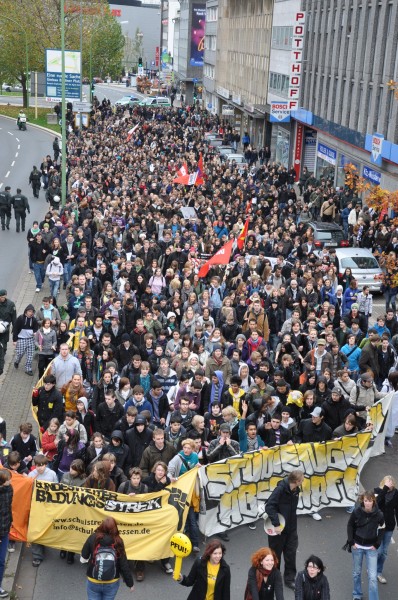
Many protests of students across Germany

90,000 lecturers, pupils, students, parents and workers across Germany protested against the increasing commercialisation and privatisation of Education (as well as the implementation of the "Bologna Process").More info...
  • 3,000 protesters on a demonstration in Essen; police attacks demonstration: 154 temporary arrests [lerex.de]

  • Further demonstrations took place in the following cities (with the number of protesters in brackets): Aachen (2,000; pix), Wiesbaden (10,000), Berlin (25,000; youtube.com), Heidelberg (2,500), Munich (10,000), Mainz (3,000), Darmstadt (500), Osnabrück (2,000; pix), Düsseldorf (4,000), Potsdam (1,000), Jena (1,500), Bonn (2,500), Bochum (700), Hannover (1,000), Cologne (3,000, pix), Regensburg (1,000), Freiburg (5,000; report), Karlsruhe (500), Duisburg/Essen (3,000) and Nürnberg (5,000) = a total of ~ 83,200 protesters

  • Lecture halls were occupied by students in Germany at the following institutions: College of Education in Weingarten, Georg-Simon-Ohm University of Applied Sciences (Erlangen; pix), University of Nürnberg-Erlangen (largest lecture hall "Audimax" in Erlangen), University of Applied Sciences in Kaiserslautern, University of Bonn [but evicted by police force shortly; pix], University of Applied Sciences in Potsdam, University of Augsburg [pix], University of Erfurt, University of Münster [re-occupied after eviction on Nov.6th], University of Jena [although police was using pepper spray on campus], Academy of Fine Arts in Nürnberg, University of Passau, University of Paderborn, University of Cologne, University of Tübingen [re-occupied after eviction on Nov.11th], University of Trier, Otto-Friedrich University of Bamberg, University of Karlsruhe, University of Siegen, Technical University of Braunschweig and Academy of Arts in Braunschweig.

University sit-ins spread throughout Switzerland

Hundreds of students have occupied the biggest lecture hall at Bern University, preventing more than 1,000 other students from attending lectures.

The protests have taken place as part of Global Week of Action – motto "Education is not for sale" – which has seen students targeting the educational machine in several European cities. In Switzerland lecture halls have been occupied in Basel, Zurich and Bern.
Continue to read this text..."Around 1,200 students have been affected," said Christoph Pappa, Bern University's general secretary. "The university administration has noted the protests, but we still don't know what their concrete demands are."

Around 100 students spent Tuesday night in the auditorium – something that hadn't been planned but followed on spontaneously from events earlier in the day - International Students' Day - when some 300 students occupied the auditorium.

The main grievances are the implementation of the Bologna reforms, the commercialisation of education (in the form of industry sponsorship), student fees and the fact that university syllabuses are allegedly becoming more like those in schools.

The Bologna educational reforms are part of the European Union's 1999 Bologna Declaration, signed by Switzerland and 45 other countries. The idea behind Bologna is to harmonise qualifications across Europe so that students and staff can move freely between universities, and the degrees they hold are recognised in every country.

Pappa pointed out that surveys last year revealed that most students judged the Bologna reforms positively.

Nevertheless he said he sympathised with criticism of certain elements of the reforms, such as the fact that instead of being given responsibility and encouraged to think for themselves, students were being spoon-fed information for regular tests.
Problems

This "exam factory" complaint was echoed by Daniel, a geography and history student.

"The big problem is that the Bologna process stops education," he told swissinfo.ch beneath a hammock in Bern University's auditorium on Wednesday.

"You can't reflect on things because you no longer have time to think and to try to go really deeply into a subject. It's not an education."

He added that another big problem in Switzerland was that the Bologna process had been in force for ten years "so people are used to it – it's not like in Germany where everything is new".

"I've been into politics for a long time so I have a solid understanding about why things are going wrong – neo-liberalisation and capitalist structures – but I think a lot of people have a feeling that things are no longer what they should be but they can't really articulate what they think, and that's a big problem."
Commercialisation

Another issue discussed in the auditorium was whether the public education system was still serving the interests of the public, or whether the focus was shifting to implement education systems that primarily serve private and business interests.

"We're concerned that the university is becoming a place where economics comes first and then education. We want a free and critical education – not some sort of training for employment," Luca, a sociology student, told swissinfo.ch.

He added that this creeping commercialisation of education was more of a problem in natural sciences "where Novartis and companies like that sponsor [courses]", but he feared that "if nothing changes, we'll see other companies trying to influence what is taught".

On Wednesday the Swiss Trade Union Federation said in a statement it was delighted by the strong participation and expressed solidarity with the students in Basel, Zurich and Bern in particular.
Support

Michael, studying economics and political science, told swissinfo.ch he wasn't surprised by the level of support.

"I think there are many students who are angry. You can't see it in everyday life as you have a tough programme and exams, but then things happen that make people angry," he said.

"For example, the political sciences institute has just scrapped a module on the social sciences BA without telling the students who subscribed [to that course]. They are now arriving without knowing that they are in fact studying something else."

He believed many people were interested in the issues, but never got around to doing anything about it.

"But when you have something like this, you see many people protesting – and not just people who normally demonstrate but a wide variety of students. This is very important and positive."

Daniel, when asked how long the occupation of the auditorium would continue, was philosophical.

"It depends how long people want to stay.

Student protests all over Italy

According to Unione degli Studenti (UdS), 150 000 pupils and students in more than 50 cities across Italy took to the streets to protest education reforms and the increasing commercialisation and privatisation of public education.

More infos...The following list of cities (and number of protesters in brackets) was published by UdS: Rome (10,000), Turin (15,000), Genoa (5,000), Naples (10,000), Bari (7,000), Lecce (2,000), Florence (3,000), Cosenza (3,000), Salerno (8,000) and many other cities.

quinta-feira, novembro 19, 2009