segunda-feira, fevereiro 08, 2010

Report of the Convention Against Fees and Cuts

Over 150 students, lecturers and campus staff, representing anti-cuts campaigns from more than a dozen campuses around the country [UK] attended the National Convention Against Fees and Cuts on Saturday 6th February in University College London. The Convention had been called to co-ordinate the fight against the massive cuts that the government and university managements have announced in education. At campuses all over the country, campaigns against cuts have been springing up over recent months, and demonstrations, meetings and strike ballots are taking place sporadically. The Convention voted to constitute an ongoing Campaign Against Cuts and Fees, to bring these different campaigns together and to organise structures and joint actions.

After reporting on the national situation in the opening plenary, delegates from local campaigns met with others from their region, to elect regional convenors and plan actions and future meetings on a regional and national level. Students and staff from the different campaigns took the opportunity to share reports on their local situation and discuss how best to mutually support each other. Regional co-ordination meetings will be taking place regularly in the North, the South, London and East Anglia; and regional and national email lists are being set up.

Continue to read the text...An open national steering committee will be meeting regularly – its first meeting is to take place on the 21st of February.

In workshops delegates discussed practical questions surrounding how best to build unity between staff and students, how to structure a campaign and run a successful occupation. The Convention also heard from students from the education strike movement in Austria, who had come to report to UK students and gather information to take back to their own campuses. The Convention resolved to send representatives to future European meetings and mobilisations, in particular the Bologna counter-summit in March. In discussions around attacks on student union democracy, students developed a charter of demands relating to SU democracy.

In the final session where the Campaign was officially launched, the Convention voted on a set of resolutions, which will be published shortly. It pledged support for the coming occupations and strikes against cuts, and support for students organising internationally, and for migrant workers organising on our campuses. The meeting voted to support the UCU’s national demonstration on the 20th of March.

The Convention also voted to call a national meeting to discuss running a united anti-cuts slate in the NUS, to strengthen the call for a real fight against cuts and fees in the student movement.

We call on all students and staff fighting against cuts to come and attend the regional meetings of the Convention, and co-ordinate their activities through this network.


The texts that were voted on at the Convention will be published shortly.

domingo, fevereiro 07, 2010

Some steps towards another Europe of knowledge

Europe of knowledge is burning.

Italy, Finland, Spain, France, Germany, Austria, etc: for more than two years, a huge wave of protests has raised in higher education and research. All of them reclaim freedom of education and fight against their enslavement by political and economical powers.

It is clear now that the various state policies are imbued with one and same spirit defined at a European level by a mix of the Bologna process and the Lisbon strategy that can be called "Lisbo-logna process".
A first move towards a global European action was taken in April 2009 with the counter-summit in Leuwen. A second move was the simultaneous protests in a wide variety of countries in October-December 2009, the most conspicuous of which took place in Austria and Germany.

From February to April 2010, from Paris to Madrid through the Vienna and Brussels counter-summits, now is the time for a European spring of global action. Now is the time to build our Europe of free knowledge.

The four steps of the event are described in the attached file.

quinta-feira, fevereiro 04, 2010

How America's Universities became Hedge Funds

In August 2009, just one month after the state of California cut over a billion dollars from its higher education budget, the University of California (UC) turned around and lent the state $200 million. When journalists asked the UC president, Mark Yudof, how the university could lend millions of dollars to the state, while the school was raising student fees (tuition), furloughing employees, canceling classes, and laying off teachers, Yudof responded that when the university lends money to the state, it turns a profit, but when it spends money on salaries for teachers, the money is lost.

Welcome to the university as hedge fund world. In this strange new world, institutions of higher learning care more about interest rates than educational quality. In fact, Harvard cared so much about reducing the cost of borrowing money that it made several expensive credit default swaps, which resulted in a loss of hundreds of millions of dollars and the halting of an ambitious expansion plan. Not only did Harvard gamble on interest rates to support future construction plans, but it moved much of its endowment into high risk investments, and the result is that the world's wealthiest education institution is now claiming poverty.
Continue to read this text...Risky Businesses

Like Harvard, the University of California was seduced by the Yale endowment manager, David Swenson, who inspired universities throughout the country to shift their investments from secure bonds and treasury notes to volatile equities and commodities. At first, schools were showing high rates of return in their investment and pension portfolios, but when these investments turned south, the universities lost billions of dollars of savings. In fact, the UC lost over $23 billion dollars in its combined pension and endowment funds, and this loss will take years to recover.

Of course, universities will say that everyone lost money in the global financial meltdown, but schools like Harvard, Yale, and the University California lost so much more than everyone else because they followed Swensen's model of shifting funds into supposedly low-risk, high-yield assets. Moreover, these schools were pushed to gamble big in their investments in order to keep up with their expensive spending habits. For the fact of the matter is that when these universities were getting double-digit returns on their investments, they continued to jack up tuition, borrow more money, and increase compensation to the top earners, but now that bottom has fallen out of their investments, they are left with no choice but to eliminate the non-tenured faculty who currently teach a majority of the students. Since it is very difficult to lay off tenured faculty, and administrators are resistant to get rid of other administrators, the only thing left to cut is the instructors without tenure, and this means courses will be cancelled and class sizes will be expanded. In short, students will be paying more and getting less because big bets did not pay off.

To understand how both public and private research universities have gotten themselves into this mess, one needs to understand five inter-related factors: the state de-funding of public education, the emphasis on research over instruction, the move to high-risk investments, the development of a free market academic labor system, and the marketing of college admissions. These different forces have combined to turn universities into corporations centered on pleasing bond raters in order to get lower interest rates so that they can borrow more money to fund their unending expansion and escalating expenses.

The Defunding of Higher Ed

Starting in 1980, as part of the Reagan revolution and the desire to cut the taxes of the wealthiest Americans, states began to reduce their funding for public universities. In order to counter this loss of funds, public research universities had to look for other revenue streams, and not only did they raise tuition to make up for the reduction of state support, but they also expanded the research parts of their budget.

This move to find new revenue through research activities was enabled in 1980 by the passage of the Bayh-Dole Act, which allowed universities for the first time to buy and sell research produced at federally funded labs. Not only did this law push universities to seek profits by selling the results of their research, but the move to increase research triggered a major expansion of administration and staff. It turns out that in order to perform high-level research, schools need to hire an army of lawyers, accountants, regulators, and staff. After all, they have to have administrators and staff to run compliance offices, regulate research centers, oversee venture capital enterprises, and to administer fund-raising activities. They also need administrators to watch over the other administrators, and then they need staff to collect the information so that administrators can watch over other administrators, and of course, these institutions need computer staff to compile the data to give to the staff so they can give it to the administrator who gives it to another administrator, and once one gets to this level of complication, one needs a whole set of other people to see if everyone is following the state and federal guidelines, and the expansion continues to infinity.

A result then of the growing emphasis on research is that the number of administrators has expanded, while the number of faculty has remained flat. For instance, during the last decade, the number of administrators in the UC system has doubled, while the number of faculty has increased 25%; in fact, nationally, there is now one higher ed administrator for every faculty member. Moreover, many administrators pull in huge salaries, and they often bring with them a purely corporate mentality that is in conflict with the stated missions of educational institutions.

Pleasing the Bond Raters

To support the expansion of research and the increased cost of bureaucracy, universities have to borrow huge sums of money. For example, during its recent financial crisis, the University of California applied for over a billion dollars for construction bonds, and almost all of this debt will go to build new research facilities. In response to these bond applications, Moody's gave the UC system a high bond rating, which will result in low interest rates, further fueling more borrowing. Moreover, as UC Santa Cruz Professor Bob Meister has revealed, the UC is using student fees and tuition as collateral for its construction bonds. In this modified credit swap, students are forced to take out subprime students loans, often charging 6% interest, so that the university can borrow money at a reduced rate.

Not only do the bond raters help to determine the cost of borrowing, but they also tell universities what they should do in order to attain a clean bill of fiscal health. For instance, Moody's slipped into its bond rating for the UC system, the need for the institution to restrain labor costs, increase tuition, diversify revenue streams, feed the money-making sectors, and resist the further unionization of its employees. Like the IMF or World Bank, the bond raters tie access to credit to the dismantling of the public sector and the adoption of free market fundamentalism.

In the case of the UC system, it appears that the President Yudof is taking his marching orders from the bond raters and is doing everything in his expanded powers to feed money into the privatized profitable sectors, while starving the non-revenue generating public areas, like instruction. Yudof's core values were revealed when he described the fiscal status of the UC system on the PBS News Hour: "Many of our, if I can put it this way, businesses are in good shape. We're doing very well there. Our hospitals are full, our medical business, our medical research, the patient care?-so we have this core problem, who's gonna pay the salary of the English Department? We have to have it. Who's gonna pay it, and Sociology, and the humanities, and that's where we're running into trouble." For many people inside and outside of higher education, Yudof's statement may seem jarring, but for bond raters, his argument makes perfect sense. From a purely financial perspective, there are profitable ventures and unprofitable ones, and only the areas bringing in money should be nourished.

Of course, lately, bond raters have been proven to be questionable experts when it comes to predicting the financial health of institutions, and in the case of judging universities, not only do the raters seem to have the wrong values, but they also have the wrong numbers. In contrast to Yudof's statement, the reality is that it is the humanities and the social sciences that actually subsidize the research centers and not the other way around. Studies have shown that humanities' programs often educate most of the undergraduate students, and they do this with relatively inexpensive teachers and low overhead. In fact, most humanities' departments turn a huge profit that is then distributed to support the supposedly profit-making sectors. Since federal and corporate-sponsored grants often fail to cover the full cost of buildings, administration, labs, staff, maintenance, and utilities, money has to be taken from undergraduates and humanities programs to subsidize the research sectors.

Marketing Academic Labor

The twin engines of increased debt and an emphasis on research have fueled a third new market force, which is the academic free agent system. In order for universities to remain highly ranked, they feel that they must compete for the best faculty, and the best faculty are often defined by how much other schools are wiling to pay them. In the UC system, for example, there is an official salary scale, but over 85% of the faculty are now off the scale, and this means that many of them have negotiated private deals with a dean. Not only does this system turn everyone into competitive individualists, but it also circumvents the peer review process that is supposed to be at the heart of the modern democratic university.

In elite private and public universities, many faculty members search for outside offers from competing institutions every year so that professors can renegotiate their deals, and these deals not only include higher compensation but also less time in the classroom. One of the results of this system is that the more universities pay star professors, the less teaching they do, and the less loyal they are to the institution. In turn, star faculty, administrators, and coaches hold universities hostage by threatening to go to a competitor. This compensation system has gotten so out-of-hand that in 2008, there were over 3,600 employees in the UC system making more than $200,000.

Marketing Enrollment

Mirroring the free market star economy is the market-based enrollment system. Universities now believe that to get the "best" students, they have to offer the best aid packages, and what has happened is that many top universities have moved much of their financial aid from need to merit. One of the problems with this structure is that merit is often based on SAT scores, and SAT scores have been shown to be heavily correlated with wealth. The end result of switching from a need-based to a merit-based financial aid system is that lower- and middle-class students end up subsidizing the wealthiest students because in order to give the top students large aid packages, the universities have to raise the tuition on everyone else.

In his book Tearing Down the Gates, Peter Sacks has shown that not only do SAT scores predict the wealth of the students' parents, and not the success the students will have in college, but SAT scores also determine a school's ranking in the all-powerful U.S. News & World Report college guidebook. Therefore, by accepting students with high SAT scores, universities not only increase their rankings, but they also bring in wealthy students who will help build the schools' endowments in the future.

The speculative market-based system that universities use to recruit students is coupled with the way these institutions spend lavishly on new facilities to attract potential enrollees. It seems that universities believe that is easier to please students outside of the classroom rather than inside, so they pour money into new fitness centers, entertainment complexes, sports arenas, restaurants, and shopping malls. Of course, all of these extracurricular activities require expensive new buildings, which require more debt, and more efforts to please the bond raters.

The expansion and revenue diversification of American universities has gotten so out of hand that research universities, like UCLA, now spend less than 5% of their total budget on undergraduate instruction. No wonder universities feel free to expand class sizes and hire people off of the street to teach required courses; instruction is just a small part of what these institutions now do, and since there are no accepted methods to judge the quality of undergraduate instruction or learning, there is no incentive for schools to put their resources into educational activities.

The lack of educational quality control in higher education results in a continual increase in tuition costs because universities have no incentive to concentrate their efforts and budgets on instruction. Since no one is rating or ranking these schools on what students are learning or how effective the professors are at teaching, these institutions feel free to spend student tuition dollars and state funding on expensive research and bloated bureaucracy. In fact, while most schools insist that students are not paying the full cost of their education, UC Berkeley professor, Charles Schwartz has shown that virtually every university inflates the advertised cost of education so that they can constantly raise tuition and use the added income to support profit-making ventures and risky financial investments.

Possible Solutions

To make the spending habits of universities more transparent and to make them prioritize undergraduate education, the first thing that has to be done is that the federal government needs to insist on a shared system for assessing instruction at American universities. Rather than basing a school's reputation on the SAT scores and the high school grade point averages of the incoming students, the new system of assessment should actually look at how much the students are learning in their classes and how effective the teachers are in promoting quality education. It is important to stress that this type of national quality control already exists, but universities refuse to publish the findings of the National Survey of Student Engagement (NSSE) and The Collegiate Learning Assessment (CLA). Instead of using these scientific methods of assessments, schools, students, and parents rely on highly questionable rating guides like The U.S News & World Report.

If education, and not just research and SAT scores, became the key to a school's reputation, these institutions would be forced to put money into instruction, and this process would reverse the current practice of using student tuition dollars to subsidize research and administration. Furthermore, once there is an accepted method for rating the quality of instruction, we can begin to drive down the costs. After all, what often makes tuition go up is that students and taxpayers are forced to fund the escalating salaries of professors and administrators who often have no connection to undergraduate instruction.

The next essential change for universities is to admit that some researchers should only research, and some teachers should only teach. Therefore, universities need to establish three types of professors: Teaching Professors, Research Professors, and Hybrid Professors. This model will help to clear up many problems because if we stop forcing all research professors into the classroom, we will be able to allow them to concentrate on what they do best and avoid what they sometimes do in an ineffective manner. In fact, the common practice of states and students paying for expensive research professors to teach ends up driving up the cost of instruction and allows people who have a proven record of being ineffective teachers to continue to lower the quality of instruction. Furthermore, the entire incentive system at research universities privileges research over teaching, and so for many research professors, we should simply make the research priority the rule and get rid of the false myth that research and teaching go hand-and-hand.

If we allow researchers to be rewarded for what they do best, we should also provide incentives for teachers to concentrate on instruction. By providing tenure for the people who do most of the teaching at research universities, undergraduate instruction can become an important priority. While some professors may say that by splitting research off from instruction, we are losing the whole point of going to a research university, studies show that the research mission often robs the instructional budget, and there is no proof that a good researcher will make a good teacher; in fact, the opposite is often the case. Once teaching becomes a priority and schools stop robbing their instructional budgets to pay for other things, it will be possible to teach students in small, interactive classes. Moreover, if we create a third class of professors, the hybrids, who would be judged equally for their research and their teaching, we can reward the people who do bring together new knowledge with effective instruction.

To help motivate research universities to make some of these changes, parents and students should sue schools for false advertising. The simple fact of the matter is that many universities present false information concerning class size and who really does the teaching at their institutions. Also, schools make inaccurate claims concerning the cost of undergraduate education, and by inflating budgets, tuition is driven up. Universities have to clearly state how they spend their money, and the federal government, which provides financial aid and research dollars to both private and public institutions, should be able to hold these institutions accountable. The government can also step in and stop guidebooks from using false and misleading information. After all, a college education is one of the most important and expensive purchases in a person's life, and accurate and truthful information should be provided.

Finally, the federal government must insist on budget transparency and a careful monitoring of how grants and endowment funds are managed. Currently, Senator Grassley is investigating how the UC medical schools are using NIH grants, and his office is trying to determine how billions of dollars of federal money are being allocated. His staff has insisted on an external audit of the medical schools' budgets, and so far the senator's office has been unable to determine if federal grants are being used for their intended use. This lack of budget transparency and clarity shows why we need to force universities to provide clear and reliable information. Without increased regulation and oversight, these institutions will continue to function as volatile hedge funds that ignore their central mission, which is after all instruction and not construction.

quarta-feira, fevereiro 03, 2010

Demo 4 «Free Education and self-determined Life»


Demonstration on January 30th in Frankfurt/M [Germany].
Temperature: - 3 degrees celsius
Duration: 4 hours

Utrecht (in the Netherlands): students occupy the University administration building

On the morning of February 1st, a group of students occupied the main building of the University of Utrecht. The students are protesting against the university's board decision to stop publishing the paper version of the University Newspaper. The action is the first of a series of national initiatives to stop budget cuts in education.

Communiqué: University of Utrecht, the Board of Directors building, February 1st 2010
Continue to read the communiqué...The Board of Directors crossed the line this time, and this is unacceptable! Despite all efforts to save the paper version of the Ublad (the University newspaper) with the support of thousands of students, professors and the complete U-raad (Council of representatives of the University community), they continue to impose their controversial policies. In the meantime, the quality of our education is at risk and our student grants are about to be cut. This is why we, the occupiers of the building of the Board of Directors at the University of Utrecht, feel obliged to take action and take a stand in favor of an independent, paper version of the Ublad, for the democratization of our University government, and against the cuts on our education imposed by the Dutch government.

By cancelling the paper version of the Ublad, it has become impossible to keep the University community informed and to guarantee a democratic voice. The University should be a place for independent thinking and should always provide space for criticism. An independent University newspaper is precisely what we need in order to move the university community to start a dialogue and become engaged with each other and society.

In our view, this issue concerning the Ublad is one out of many attempts to transform the University into a company where the Board and her professional managers have their way at the expense of democracy, quality, diversity and scientific integrity. These core values which the University must represent, should be reflected in the way the University is governed. In fact, the University should be directly governed by the University community itself, instead of a non-democratically chosen clique.

Our concerns are not limited to Utrecht, because we are faced with drastic nationwide reforms such as the budget cuts on education, the possible cutting of student grants, the implementation of BSA (Binding Study Advice), and our minister of Education’s neglect to defend the proposition for a ‘student assessor’(a student in the Board of Directors). The position of the University and education in society is too important to be left up to and controlled by market mechanisms. This global process is negatively affecting education worldwide and has to be stopped immediately!

In Europe and the rest of the world, protests against this process are visible evidenced by the almost hundred occupations and mass demonstrations in the Global Week of Action in November 2009. Now it’s our turn and we demand the following:

  • The Ublad in its current paper format with an independent editor must be permanently secured by the Board of Directors of the University of Utrecht.
  • The U-raad of the University of Utrecht has the right to demand binding referenda, facilitated by the University of Utrecht, for issues they consider important. This will be recorded in the statutes.
  • The U-raad of the University of Utrecht will get a direct voice in all decisions made by the Board of Directors of the University of Utrecht by a right to a fixed vote by U-raad majority and a veto right in case of unanimity of the U-raad.
  • All participants and others involved in the occupation of the University of Utrecht on the 1st of February 2010 will be exempted from all charges, now and in the future, by the University of Utrecht and other parties and may leave the occupied building and terrain without involvement of other parties.
  • The current minister of Education, Culture and Science, Mr. Ronald Plasterk, will publically offer his apologies to the Dutch people for the deterioration of education during his watch.
  • The cabinet will publicly announce to stop the budget cuts and ensure more investment in higher education per capita.
Our duty as student activists will not be over until we are heard and our demands are met. Therefore, we encourage all students, teachers and parents to resist the structural deterioration of our education and take a stand for decent public education that everyone is entitled to.
Save our education!

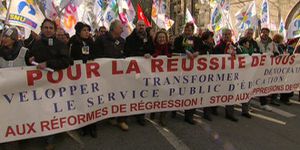
France: national demo for public Education

On January 30th, a national demonstration for public Education gathered between 8.000 and 12.000 persons in Paris.

We were fighting against cuts, programs weakening, and suppression of thousands of teachers jobs, and against the reform of the recruitment of the teachers which opens the doors to the employment of teachers without the status of civil servant.

terça-feira, fevereiro 02, 2010

Scotland: protest against cuts to education

On Wednesday 27 January, students and staff from schools and universities all over Scotland gathered outside the Scottish Parliament in Edinburgh to demonstrate against cuts to the education budget.
The protest was called by Edinburgh University's Student Association and supported by the Educational Institute of Scotland, UCU and NUS in response to the cuts being faced by Moray House, the school of education at the University of Edinburgh. The school may have to cut around 300 student places, which could in turn lead to up to forty staff redundancies. This comes as the Scottish Government abandons its election promise of cutting class sizes in primary education. One student questioned how staff were to roll out the so-called Curriculum for Excellence, which has the stated aim of achieving "a transformation in education in Scotland by providing a coherent, more flexible and enriched curriculum," while contracting the "excellent teachers" who could deliver it.

About 150 protesters marched from Moray House to the Scottish Parliament where a delegation from UCU went in to speak to ministers. While outside, the protesters chanted and sang songs and were met by several MSPs, including Richard Baker, MSP for the North East region of Scotland, who came out to show their support. During the protest, a class of school children were being given a tour of the parliament building and clapped and cheered when going past the protesters.

Towards the end of the rally the demonstrators were addressed by the Shadow Minister for Schools, Ken Macintosh, EUSA's external convenor, Katherine McMahon, and a UCU representative.

The demonstration was followed by a meeting where groups from different universities, including the Aberdeen Defend Education Campaign and the president of NUS Scotland, Liam Burns, discussed how to coordinate action against cuts to the education budget, in particular Lord Mandelson's proposed 950 million pound cuts in higher education spending.

A statement from the president of Dundee University's Student Association called on students to oppose the view that universities should be run as businesses. "Education is the bedrock of any society and needs investment."

Terry Wrigley from the UCU pointed out that the Government has money to bail out the banks and rebuild trident, but that when it comes to education and other public services people are told that they will have to pay for the recession.

Aberdeen Defend Education Campaign

Nigeria: students protest hike in tuition fees

Academic activities at Ebonyi State University (EBSU) were partially paralysed yesterday following peaceful demonstration by the students, mostly non-indigenes to press home their grievances over the disparity in the recent increment in school fees of indigenes and non-indigenes.

The students numbering over 2.000 took to the streets of Abakaliki, the state capital and marched from their permanent site to the College of Agricultural Sciences (CAS) campus which harbours the administrative headquarters of the university, as they chanted war songs.

The protesting students also complained of high price of private hostel accommodation in town due to non-residential system of the university, insecurity of students, inadequate social amenities in the school and alleged government interference with the activities of the Students Union.

Placards carried by the students had inscriptions such as, "say no to 10 per cent reduction in EBSU school fees", "share it 50-50", "reduce the school fees now", "say no to discrimination in EBSU" among others alleged that the school management recently increased the school fees from N19, 000 to N80, 000 for non-indigenes and N19, 000 to N60, 000 for indigenes.

Continue to read the text...The protest that started in the earlier hours saw the students blocking most of the major roads leading to the university main campus, Ezzamgbo, disrupting the on-going examination at the main campus before marching to the other campuses in the state.

At Ishieke and the College of Agricultural Sciences (CAS) campus of the institution, the students disrupted commercial activities in the area forcing most shops and filling stations to close their business premises while commercial and private vehicles near the area deserted the streets temporarily as the students were carrying logs, fresh leaves and chanting war songs.

The students described as unfortunate the recent increment in view of the economic hardship in the country regretting that the increment is so exorbitant that most parents are left with no option than to withdraw their wards from the school.

Some of the students who spoke to the Daily Champion on condition of anonymity criticised the disparity in the school fees of non-indigenes and indigenes urging the state government to reduce the increment and make the school fees uniform.

"The school authorities can not go on and increase school fees without the provision of necessary facilities that are expected to be in a higher institution. It is so unfortunate that the school does not have a single hostel, no toilet facilities; we don't even have good drinking water in the school. Now that the school fees have been increased, we expect them at least to reduce the fees and make it affordable for parents".

"The authorities should also use the proceeds to build hostels and provide other amenities in the school. This would generate fund for the school rather than increasing school fees. We call on the state government to look into our plight as most of us; our parents cannot afford N80, 000 every semester".

When our reporter placed a call to the Public Relations Officer of the university (PRO), Mr. Larry Udu his telephone rang out. However, the Personal Assistant to the State Governor on Higher Education, Prof. Mike Otuma when contacted said the State government was shocked over the protest noting that after due consultation with the students union, the school management and the state government, the school fees was recently reduced by 10 per cent.

He urged the students to always embrace dialogue in resolving issues with the school management adding that the state would also invite the leadership of the students' union body and the school management to further dialogue on the issues.

domingo, janeiro 24, 2010

Anti-Privatization protests and Demands @ UW

On Thursday of last week, over 100 students, workers, local alternative high school students, teachers, and staff came out in the first action called by the University of Washington Student/Worker Coalition.

The day started with over 35 people protesting an abusive manager at her office. This action came a little over a week after Democracy Insurgent called a solidarity protest against Andre Vasquez. Workers in International Workers and Students for Justice were inspired, and took up this protest as the leaders, speaking out into the bullhorn against abusive managers. This is a huge step, considering the enormous amount of repression and abuse faced by workers who have been organizing for their rights. Following this confrontation, many of the workers marched with students, staff and community members to confront the board of regents. About 50 students and workers went to confront them on the barricaded 22 floor of the UW tower, a militarized space, while others stayed downstairs and chanted and read demands outloud, bringing support from employees at UW tower. Some of the chants included "Enough with the Ivory Tower, we fight back with Student/Worker power!" and a tip of the hat to UC schools with "No Cuts, No Fees, education must be free! See video of both actions, and other actions called by workers and students at youtube.com/dinsurg. Check out posters and flyers at nobudgetcutsuw.blogspot.com.

Also, below, see the full letter of demands delivered to the Board of Regents.

Continue to read the text...We are members of UW Student/Worker Coalition (UWSWC). As the University announces a second round of budget cuts, students and workers have come together to form a coalition to fight against not just the fact of these cuts, but their implementation and the privatization of the University as a whole.

Support these cuts, and the University of Washington takes another step towards privatization that leads to exclusion. Education at the UW is sliding into mediocrity and . You cannot wash your hands of this.

The UW Student/Worker Coalition demands the following:

DEMAND #1. Transparent and democratic budget allocation
UW is a public institution in a purportedly democratic society, but it increasingly resembles a for-profit corporation. Today we are in a board room on the 22nd floor of a high-rise that used to be occupied by an insurance company. We are standing in front of an unelected board comprised mostly of business elites. Tens of thousands are affected by decisions made in this room, but there are only spectator seats here for a few dozen. Regent meetings are scheduled at an hour when many UW workers who will be most affected by budget cuts, like custodians, are unable to attend, even if there was room for them. We requested that you move this meeting to a time and place where workers and students could attend to have their voices heard. But you refused. Today, you allow a handful of us to watch you rubber stamp your (quote) "consent agenda." Our presence here does NOT lend legitimacy to your public spectacle. We are here to tell you our agenda, with or without your consent. We will no longer be excluded.

Decisions must be made by those who are most affected by them. That is democracy. It cannot exist so long as the university community is denied access to and participation in decision-making processes that determine the distribution of campus resources. We are the university, and we demand power.

DEMAND #2. Cut from the top administrators: cap all salaries at $150,000 per year
It is often said that high-level administrators deserve higher salaries because they bring in money for the university through solicitation from donors. We reject this. The hardest work done at the U is done by those lowest paid; keeping the university clean and operational, teaching students how to read, write, and think, and making sure students and workers get what they need. CEOs know NOTHING about maintaining buildings, or teaching classes, and should NOT be making the most money at the U! High-level Administrative salaries are inflated by at least 20% at the same time as unionized workers are fighting for raises of 2-3%. This difference is arbitrary and irrational. ALL OPTIONS SHOULD BE ON THE TABLE. Administration IS NOT SACRED, and cuts to top-level administrative salaries MUST be considered as a valuable source of funding. We do not expect anyone making over $150,000 annually to face eviction if their incomes are constrained to a reasonable level.

DEMAND #3. No layoffs
The University of Washington has used the budget cuts as an opportunity to selectively lay off the lowest paid and most necessary workers on campus. Layoffs have included custodians, professional and classified staff, trades workers, TA's, writing center staff, librarians... the list goes on. As is typical of private restructuring of formerly public resources, those who perform the most necessary functions of the university: cleaning, maintaining buildings, teaching students how to write, read, and study, are also the lowest paid and the first to go. Layoffs have also disproportionately affected immigrant workers, people of color, and women at this University. Meanwhile, upper level administration and managers are INCREASING. The U has consistently laid off union workers to hire part time workers for less money with no benefits in their place, or to out contract jobs to private companies! This hurts ALL workers and students at UW, not just those who are laid off. In addition, facilities services has implemented a LEAN methodology. This is similar to abusive practices used on auto-making assembly lines. The UW is NOT a factory, and we know "increased efficiency" means abusing workers, an unsafe university for students, and more money for those on top! We demand an END to LAYOFFS and a REHIRING at PREVIOUS RATES of laid off workers!

Demand #4. No speed-ups for workers
Vacancies left by layoffs, firing, and restructuring have led to campus wide speed-ups for workers. For custodians, this has meant an increase from 30,000 to, in some cases, 85,000 square feet of cleaning, leaving workers injured and spaces less clean. For trades, this means a shift from preventative maintenance to keep us safe, to emergency fixes. In the last three years, there have been almost 300 reported injuries in custodial services, many due to over-exertion and other results of speed-ups! For administrative staff, this means less time to help with applications for students, mistakes in payrolls due to overwork, a decrease in access to technology, and stress on the job. For TAs this means less time with students, and a poorer education for undergrads who are paying MORE for education. Speed-up is worker abuse, and a University cannot exist on the basis of continual oppression and exploitation of its workers and students. End Speed Ups for all workers!

Demand #5 Prioritize an open, accessible public education for all.
Increase access to universities for students who are people of color, low income, working class, queer folks, immigrants, women, and folks with disabilities.
In the past, UW has been accused of being an "elitist" institution. This assertion was based in part on the HUGE salaries made by top level administrators, but also because the UW is increasingly exclusive! The high tuition/high aid model is a joke for working and poor students. The only way to make the university accessible is to LOWER tuition; not raise it and then make students of color, poor students, and working students jump through impossible hoops like circus animals to get your pittances. The reality is, working students, students of color, immigrants, women, queer folks, folks with disabilities ARE this UNIVERSITY! We should be at the forefront of the University as primary participants in our own education. We will fight together to take back the University.

Demand #6. Freeze Tuition!
We know that many budgetary decisions are made in Olympia. But we know that you make decisions about the allocation of resources on campus and about how the UW defines its priorities. We also know that the UW has been lobbying hard to have the legislature lift the tuition cap, so that you would be free to raise tuition even more than the already astronomical twenty-eight percent two-year increase. A twenty-eight percent increase! We will not tolerate this shakedown of students from either elected officials, or from you. We will fight to make UW a public university. Any increase is unacceptable. Any increase makes it even more difficult for working students and students of color to access an educational system already bent on marginalizing them within it or, worse, excluding them altogether. We demand that you freeze tuition, as a first step towards creating open access to higher education for everyone. Students will not pay more tuition so that Emmert's personal budget can reach seven figures!

Demand #7. Increase need based aid by replacing loans with grants, and stop calling loans financial aid!
What's called "financial aid" deceptively includes merit-based grants and loans, in addition to need-based grants. If we're honest, merit based scholarships are little more than bribes designed to lure students whose GPAs and SATs will increase UW's rankings over its peer institutions. Usually, such scholarships do not provide aid to those who need it to access higher education. Loans are repaid in full with exorbitant interest, often generating handsome profits for lenders. A car loan is not financial aid. A payday loan is not financial aid. Student loans are not "aid." We demand that you stop calling loans aid. It is dishonest and misleading. More importantly, we demand that you expand real financial aid. This means increasing need-based grants that allow low-income students and students of color to access higher education without saddling them with devastating, lifelong debt. If you think you can't afford this, take out a loan.


We are watching you. This community has not been seduced by the market-driven business model. Why are we here? Many of us have younger siblings, children, and friends in this community; we are also working people who need secure jobs with benefits, fair wages, and safety. We are here for not only for our future but for the future of education. We refuse to accept this agenda as inevitable. We will not submit to a death by a thousand cuts. We will not have our university sold out from under us BOARD OF REGENTS, YOU CLAIM TO EXIST TO SERVE OUR INTERESTS. WE DEMAND YOU ANSWER TO US.

sábado, janeiro 23, 2010

Overview of worldwide Education protests in 2009

Here you will find the result of an attempt to list most of the protests related to "neoliberal reforms" within public education systems around the world. Hundreds of actions in 51 countries on 5 continents were recorded.

A similar list for the past two years: 2008 and 2007.

segunda-feira, janeiro 18, 2010

Call for the European Education Congress 2010

The Congress is open to all people who are interested in education and depends on everyone to contribute to it. In order to have a wide discussion during those five days, we would like calls from as many people as possible for the Education Congress.

To us, education is a precondition for participating in social processes. However, the current educational system is in many aspects not able to enable people to understand social interrelations and to empower them to a mature taking part in social changes. But only if everyone participates, a society can develop which guarantees the most broad level of freedom for all individuals and thus finds the most broad level of acceptance.

At the same time we come to the conclusion, that the goal of establishing free education for everyone worldwide seems to have moved out of reach for some time to come. The educational system is cross-nationally exposed to different reforms. It is time to analyze these changes, especially in context to the whole of society, and to develop alternatives to the status quo.

Continue to read the text...Therefore we want to discuss together: What functions do school systems and systems of higher education have in different European countries and regions? What does self determined living and learning mean? How can we establish free access to education for everyone? How are educational system and society related to one another? Do institutions of higher education produce social inequality and how could this inequality be broken? How can we establish democratic, self determined structures at schools and institutions of higher education? What is commercialization of education, what influence do commercial enterprises have in this process and how can this influence be broken? How and for what aim can European-wide solidarity be established?

This congress should facilitate a Europe-wide exchange, analyzing the context of education and society. We want to give attention to decision-making processes of society to establish a democratization of society.

Thus, for everyone interested in education and education policy: come to the European Education Congress from the 1st to 6th of June 2010 at the Ruhr-University in Bochum!

We invite you to spend five days with us, analyzing the current educational system and its functions critically. Let us think about the meaning of good education, what the requirements of a progressive educational system are and which paths could lead to such a system. This will be done in different methods of learning such as workshops, plenary meetings, lectures, panel discussions and concrete experiences. All supporting persons and groups are called to bring in such activities of their own, to introduce texts and to contribute to the congress. At the same time there will be enough time to exchange experiences from single countries and regions and for international networking to enable further cooperation.

slated date: 1st to 6th of June

quinta-feira, janeiro 14, 2010

Build up a transnational network of struggles and resistance: within and against the global University

Since its beginning, edu-factory has tried to be a place of political discussion and communication, a site of the free circulation of knowledge and networking at the global level. In the “double crisis” (i.e., the global economic crisis and the crisis of the University in ruins), the edu-factory list and web site have been enriched by communiqués from different collectives, news of University occupations and demonstrations, as well as proposals for political organization (i.e. George Caffentzis and Silvia Federici’s proposal). In fact, on March 4th there will be a day of mobilization in universities across the United States (www.defendeducation.org); on the 11th and 12th of March there will be a European mobilization against the Bologna Process (bolognaburns.org) in Vienna; and, in general, many struggles are challenging the corporatization of the university all over the world. We present the following text as an open proposal: please comment and add, in order to build up a common process of transnational discussion and organization. We want to emphasize the importance of a common process. Only in this way, can we build up a collective with free and equal participation, which is to say, a new common politics, or a transnational politics of the common.

In the last year, many struggles and movements have emerged at universities all around the world. These struggles are more and more articulated at the transnational level through their financial dimension and through knowledge production in the education factory.

Continue to read the text...What do we mean by edu-factory? We mean that it is impossible to understand the transformations in the university without linking them to transformations in labor and production. Because new forms of valorization and accumulation make knowledge a central commodity, the role of the university changes definitively. It becomes a sort of “knowledge and education factory.” Notwithstanding, there is an irreducible difference between the industrial factory and the supposed new one. This difference is related to the particularity of the good that is produced in the university, i.e. knowledge. In fact, knowledge is not a scarce commodity: on the contrary, its richness comes from social cooperation and collective use. The production of knowledge is thus without measure. It is inseparable from living labor. Knowledge is always living knowledge. This difference is the main source of the struggles against the becoming corporation of the university, its imposition of an artificial measure, and the enclosure of free knowledge.

What do we mean by the global university? We mean that the standpoint to understand these transformations must be a global one. The global is not at all a homogenous space. There are global trends – corporatization of the university, commodification of knowledge, marketization of whole ways of life, the rise of a new figure of the student and the academic worker, and then, layoffs, budget cuts, tuition fee increases, etc. – all with different forms of declination and translation in different contexts. The global is based on heterogeneity. The global is a battlefield. We have no nostalgia for the national borders of the university and knowledge production. Local action is important, but it is not enough. We want to build up a transnational politics, within and against the global university.

What does it mean to struggle in the global edu-factory? This is the central question. In the last years, there have been struggles all around the world, with different languages and paths, and with similar goals and claims. In the double crisis –the global economic crisis, and the crisis of the modern university– these conflicts are increasing. It is important not to be rosy eyed or romantic about this situation. Because the double crisis brings suffering, it does not necessarily furnish a privileged opportunity to change the world that produces this suffering. Far from seizing the moment in a Messianic way, it is necessary to pursue the transformation of the university in, through and against the current global turbulence and the initiatives of governance that it has occasioned.

In this framework, how can we articulate the struggles over the division and hierarchisation of knowledge, its geographical division by the constitution of modern macro-regions, and the material struggles that currently unfolding? Within the urgency of these struggles, how can we develop the project of edu-factory as a dispositif beyond the simple communication among struggles in order to articulate and circulate different temporalities and political processes in a transnational dimension? From the occupations against the Bologna Process in Europe to those against fee increases in California, there has been collective reflection over the quality of knowledge and access to the university for the students who refuse to only be indebted clients. How is it possible to find and construct a common place to share conflicts, to discuss at a transnational level, and to improve our collective force?

Since we don’t want to propose a universal recipe, but rather to construct another world and another university based on already existing struggles, maybe we should also aim to create a transnational network of struggles developing from specific contexts – immediately connected at a broader global scale.

For example, the struggle within and against the Bologna Process has to be immediately a global struggle: not only because the global university think tanks are trying to export the Bologna Process to North and South America, to Asia and Australia, but because it’s impossible and ineffective to build up a network that isn’t immediately a transnational network. This is a place of translation from within, instead of only between different processes and temporalities.

It’s important to say that we don’t imagine a global network of struggles as a circuit of many national networks. In other words, we don’t think of the transnational network as a simple place of national translation and international linking. We want to call into question national borders, because the local spaces are definitely changed by the mobility of people (for example, we can point to the strategic importance of international and migrant students in universities all over the world). We want to dismantle the apparatus of ‘area’ in both its material and cognitive dimensions, seeing that it is an instrument to govern populations and convert singular knowledgeable bodies into normalized bodies of knowledge.

Therefore, we propose to build up, and experiment with a new politics, that is, a transnational politics that tries to work through the translation of struggles and militant research. We have to re-open and re-invent social inquiry: militant research can define the political method of critical analysis, invention and social insubordination in the political phase. To restart militant research means, first of all, that the learning phase is part of the political one, that we must crossbreed knowledge with practice, reflection and experience. Doing social inquiry means setting up tools of action, intervention and organization. To build up a network of struggles is to ask: how can we, today, do militant research?

In this context, we propose to all students, researchers, teachers, academic and “precarious” workers, collectives, groups, movements: let's build up a transnational network of struggles and resistance. That is, an autonomous network to spread news and materials, to share texts of militant research among different struggles and temporalities, to organize ourselves within and against the global university. A transnational network of struggles and resistance is not at all a supposed universalistic organization or an identity-making subject. In fact, we’re against standardization, that is, the universal language of the global university. We support differences and multiplicity, and their capacity to find and invent common practices and lexicons. The commonality of struggles is always against the empty universality of power. A network of struggles and resistance has to be a self-organized translation machine to empower singular movements, and to improve its possibility to win. A network of struggles and resistance has to be a common process of research within autonomous movements and groups. A network of struggles and resistance has to be a common space of translation of the different languages and practices, that is to say a common place from which to dismantle the conditions that support the regime of unilateral translation. Only in this way, can a network of struggles and resistance answer in a collective way the central question: how to build up a transnational politics of the common against the global university?

terça-feira, janeiro 12, 2010

Call from Vienna: make Bologna-process history!

Celebrating Bologna-process? We don't think so.

International call for participation

On March 11 and 12 2010 the Education ministers of 46 European countries will celebrate the 10-years anniversary of the Bologna-process in Vienna and Budapest. Considering the current situation and the ongoing protests in many European Universities this celebration is a mockery for all of us.

Not only has the Bologna-process clearly failed to achieve the agreed goals of improved mobility; it also led to more restrictions for students and their studies and to greater social selection of access to higher education in general.

The fact that the entire process is based on the understanding of education as only producing workforce dictated by the market is reflected in the agreed goals. Therefore our aim is not only to measure success or failure of the Bologna-process but furthermore to question the process and its foundations itself. Master and PhD as elite programs, which especially exclude women, introduction of study fees and under-financing of universities as well as de-democratization within the university system are obvious symptoms.

The difficult financial situation increases the corporate influence on education and scientific research. The orientation of teaching towards corporate interests does not only affect universities, but the entire education sector in general. Hence the possibilities of self-determined and critical learning are restricted.

In view of this disastrous situation we don't see any reason to celebrate the Bologna-process. The European-wide protests of students, teachers and others show that the economization of education is directed against their interests.

Therefore the week from 8 to 12 March 2010 shall accompany this conference with demonstrations, strikes and blockades as well as a counter-conference, where we are going to discuss European education policy, as well as the common goals of our protests.

We formed four groups, which focus on different aspects of the event:
  • Demonstration/blockade: for the time the ministers are holding their meeting we are organizing a demonstration (Thursday, march 11). Different ideas of blockades are being discussed.
  • Strike: using the occasion of this event, we are planning to go on a university-strike in cooperation with the teaching staff for at least two days.
  • Counter-conference: in this part of the event, we want to work on, discuss and exchange experiences openly about the bologna process and possible better education policies.
  • International mobilization: a big part of this event should also be the gathering of all the protesters from different countries and fields in order to work on a common strategy.

We want this event to be organized and held by all protesters together. This is why we are calling for your participation not only at the event itself, but also during the preparations (eg.: input at the counter-conference, etc.).

Together we will show that we do not agree with the celebration of a process, that limits education to the production of human capital!

This protest and its further development lives from our participation!

segunda-feira, dezembro 21, 2009

National Convention Against Fees and Cuts [@ UK]

On 6th of February UCL Students for Free Education will host the National Convention Against Fees and Cuts, an all-day conference of action, discussion and entertainment for anyone who thinks higher education should be free for all. We are looking to call the conference in co-operation with all sections of the student movement still willing to stand and fight – especially sympathetic unions. With a relentless assault of cuts, threats and marketisation from the Government, and an NUS leadership unwilling to seriously challenge it, there is a real danger that Free Education – until so recently a reality – could fall off the political map altogether.

If Free Education is to remain on the agenda, it is now more vital than ever that the student movement set out its stall and reclaim the momentum. In part, this will mean restating what we stand for – that education is a right not a privilege, that it should be democratically controlled for the benefit of all. But most crucially we must set out our stall, commit ourselves and our organisations to a renewed and organised struggle against cuts and marketisation, as well as properly addressing the wider questions – what should education be about, and how could and should it be funded if not by us?

Continuar a ler o artigo...A National Convention should give us an opportunity to address these questions, and to reignite student activism about education. It will also give us a route to participating internationally: we look to invite speakers from abroad, and to draw conclusions from the international fight for Free Education.

And, as, always, we will need to do that thing so seldom mentioned by earnest gatherings – have fun! We anticipate big attendance, free food, comedy, music, high-profile speakers and bags of opportunity to contribute.

If you are active in an organisation or Union that is sympathetic to Free Education and might be willing to support the conference, please get in touch with us at ucl.free.education@gmail.com We will be looking to co-ordinate the collaborative elements of the conference – such as a possible ‘declaration of fighting Unions’ – with all of its supporters at some point in early autumn. Please get in touch, and join our Facebook group.

We will be working on the logistical aspects of the convention for some time to come, but we are already aware that it will be difficult for some to attend all day without some kind of accommodation, and will be drawing up a list of people willing to host.


sexta-feira, dezembro 18, 2009

quinta-feira, dezembro 17, 2009

Student movement in Croatia: stronger than ever

For the past two weeks, over 800 students have participated in the blockading of the filosofski fakultet, one of the main university buildings in Croatia’s capital Zagreb. Just over two weeks ago, a plenum was held with the decision made to occupy this building, where much of the social sciences and arts/humanities teaching takes place, and to block all teaching taking place there. This might seem short-sighted at first glance, as students themselves are the first to feel the ill-effects of no teaching. But the decisison was made, and was necessary to highlight how seriously students oppose the current government’s attempts to create a market in education, and to make students pay for this ‘privilege’. Two weeks of tuition lost to this generation of students is nothing compared to the years of university level education which many future potential students will lose as a result of not being able to afford to go to university. The blockade was impressively well organised. Students made sure the building was kept clean. The consumption of alcohol and smoking were forbidden inside the building during the blockade, and students organised themselves into groups of redari (monitors) who kept tabs on what was going on in every classroom in the building. I volunteered as a redar almost every day and it was interesting to see just how much the blockade had polarised the students and the professors. Whilst the majority of professors were in favour of the blockade, a few departments had a majority against the student action. The most significant department voting against being unsurprisingly (to those who know a little about the history of Croatia), German studies, who persistently tried to hold classes on a day to day basis. An alternative lecture programme also took place, with 3-5 guest lectures taking place on a daily basis. I gave a workshop on the commericalisation of education in the UK, with special focus on Manchester University, and how students have organised themselves against such neoliberal impositions, and crucially, how the struggles currently taking place in Manchester, Croatia, Serbia, Germany among others are connected.

Continuar a ler o artigo...The most shocking aspect of the blockade was without a doubt the mainstream media coverage. Public opinion in Croatia is generally in favour of free university level education, certainly at the undergraduate level (currently only the first year is free to a majority of students, although some have to pay for all three years. The students were pushing for free higher education at all levels). With this in mind, during the last blockade (last April, *check*), the main newspaper Jutarnji List was subtle in its opposition to the blockade. This time around however, they were bluntly open in their demonisation of the blockade, the national front page headline reading “Stop terrorizing those who want to learn” (Prestanite terrorizirati one koji žele učiti). This headline was accompanied with a picture of the student protestors outside the faculty with a banner, but Jutarnji List had stamped a new slogan over the banner: “The future is our work” (Budućnost je naš posao). Incidentally, this headline is also a slogan scattered across advertising boards over the country for one of the main social democratic candidates (Milan Bandić) vying for presidency, national elections taking place in Croatia on 27th december.

However, the protest did receive some positive media coverage in the left wing media (most notably in Zarez) and the students organised workshops on media representation and coverage of the protests. The blockade in Zagreb was part of a wider series of blockades at several universities throughout Croatia, including Rijeka and Osijek. As a result, the government have yet again postponed indefinitely the introduction of a new law which would give a centralised management committee the power to veto staff decisions made in university departments, thus taking power away from lecturers and reducing the intellectual autonomy of the university. The blockade has not only been victorious in this vein, but has also been crucial in opening a big public debate on higher education funding, with the vast majority of the public being in favour, even including many students who were against the tactics of the blockade (not knowing that the other main option students could take to voice their concerns, the student council (studentski zbor) had been coopted by a clique of corrupt social democrats close to the main political parties (HDZ, SDP etc) and who were keeping suspiciously silent regarding the struggle for a free education. A story which sounds familiar to many readers in England following the NUS debate perhaps?
Students voted yesterday (friday) to end the blockade and are now spending this weekend carefully tidying up the faculty building ready for a return to lectures on monday. The decision was made to continue with the blockade next term, having shown the government that they have the means, human-power and public opinion behind them, and that they are willing to continue to fight against the proposed neoliberal reforms until their goals are realised.

terça-feira, dezembro 15, 2009

National Call for a Strike and Day of Action to Defend Public Education [on March 4th, in USA]

California has recently seen a massive movement erupt in defense of public education — but layoffs, fee hikes, cuts, and the re-segregation of public education are attacks taking place throughout the country. A nationwide resistance movement is needed.
We call on all students, workers, teachers, parents, and their organizations and communities across the country to massively mobilize for a Strike and Day of Action in Defense of Public Education on March 4, 2010. Education cuts are attacks against all of us, particularly in working-class communities and communities of color.

The politicians and administrators say there is no money for education and social services. They say that “there is no alternative” to the cuts. But if there’s money for wars, bank bailouts, and prisons, why is there no money for public education?

We can beat back the cuts if we unite students, workers, and teachers across all sectors of public education — pre K-12, adult education, community colleges, and state-funded universities. We appeal to the leaders of the trade union movement to support and organize strikes and/or mass actions on March 4. The weight of workers and students united in strikes and mobilizations would shift the balance of forces entirely against the current agenda of cuts and make victory possible.

Building a powerful movement to defend public education will, in turn, advance the struggle in defense of all public-sector workers and services and will be an inspiration to all those fighting against the wars, for immigrants rights, in defense of jobs, for single-payer health care, and other progressive causes.

Why March 4? On October 24, 2009 more than 800 students, workers, and teachers converged at UC Berkeley at the Mobilizing Conference to Save Public Education. This massive meeting brought together representatives from over 100 different schools, unions, and organizations from all across California and from all sectors of public education. After hours of open collective discussion, the participants voted democratically, as their main decision, to call for a Strike and Day of Action on March 4, 2010. All schools, unions and organizations are free to choose their specific demands and tactics — such as strikes, rallies, walkouts, occupations, sit-ins, teach-ins, etc. — as well as the duration of such actions.

Let’s make March 4 an historic turning point in the struggle against the cuts, layoffs, fee hikes, and the re-segregation of public education.

The California Coordinating Committee

segunda-feira, dezembro 14, 2009

El Plan Bolonia explicado sin rodeos [video]

Aqui teneis a un decano (Juan Carlos Mejuto) de la Universidad de Vigo, aclarando de una vez que es Bolonia... Sin tonterias ni florituras.
El video entero dura 11 minutos (YouTube limita a 10) y partirlo era un poco raro, así que he dejado sólo lo referente a Bolonia, y no el trocito en que critíca el sistema universitario gallego. Si alguien quiere verlo entero, podeis sacarlo aqui.

sexta-feira, dezembro 11, 2009

DAY OF UNIversiTY will be @ 17th of December '09

Dear friends and occupants,

We are still here, those cr itical students who are not prepared to accept the current situation at our universities. The sale-out of education, access barriers and the de-democratization, which is going on at our universities, still need to be stopped, since the people in charge haven’t yet realized that it’s high time they reacted to our claims and angle off 180 degrees into the only right direction there is: the direction of free education without barriers.

Thus, the struggle against those who want to take us for fools a nd want to sell out our education, must continue – even before, during and after Christmas holidays.

Many people in Austria and other European countries have no idea about the fact that there are many more universities occupied than only the ones in their country. Many people don’t have the slightest idea that there are more than 100 universities either occupied or somehow involved in the protests. You can see the occupied universities under this location.

Many people have not yet realized that thousands of students all over the world are standing up for their rights, and not only fight for themselves, but also for the next generation and for a better future in general. It is now our job to stop the ignorance!

The people out there should realize that the protests are not only a “local” problem of each country, but that the whole society all over the world is affected by the grievance which we, the students, are pointing out and which against we are defending ourselves. Therefore, we would like to invite you to participate in the

DAY OF UNI(versi)TY – United for free education!

on Thursday, 17th Dezember 2009

Especially before Christmas, the majority of the consumption-oriented population is busy with shopping, instead of getting concerned about the real problems, whose solving is long overdue! Let’s wake up those people and let’s show them that we are standing behind our claim f for a free education in unity and that this issue concerns each and every one of us.

The "International Day of Action“ was yesterday. Tomorrow, we will appear before the public in unity under the slogan DAY OF UNI(versi)TY, far beyond our own country borders.

There are some universities which are not yet as widely mobilized as universities in Germany, Austria and Switzerland. That is why we have come up with the idea to plan a common operation/campaign/activity, which can or even should be carried out by all participants of the protest movement for free education in their cities. Of course, it would be great if this could happen simultaneously, in order to demonstrate our unity, despite spacial distances.

Continuar a ler o artigo...Our ideas:

On the 17th of December 2009 at 11 o’clock in the morning, students go out on the streets in numerous cities in Europe and worldwide. We will be equipped with signs, posters or banners which carry the names of all occupied or involved universities. The signs might say: “We are Heidelberg”, “We are Paris” or “We are Vienna”. The people should see in which cities universities are occupied and in which cities there are student protests.

At the same time, flyers can/should be handed out to passer-bys to inform them about the current situation. In the centre of each city a flashmob or different activity should take place. There are no limits as far as creativity is concerned!

Possible actions could be, for example, a “reading-demo”, which is a silent demo where all participants sit or lay down on the street and read or study something. Another possibility would be to act out some kind of choreography with the signs or to form a certain figure, like a country or a university. Another idea is to act out a scene in the style of a street theatre. Or what about a big pillow fight?

Anyway, it is important that we all have the signs with the occupied universities in common in order to demonstrate unity and solidarity. The more we are, the less they can ignore us!

Let’s not hide but stand up for our rights together!

The actions should, if possible, be video-taped. Afterwards we will put the sequences together and create a small documentary about the “Day of Unity”, including all the activities from the participating universities, which we will publish on YouTube.

Please let us know, whether you are interested in participating in the “Day of Unity”. If yes, then please organize yourself, mobilize and join the united movement. Inform the people out there, whether the media, friends, acquaintances, relatives, students of high schools, etc. Invite everybody to participate in solidarity in the event.

Everyone should know that and why we are here and that we won’t be gone too soon!

quinta-feira, dezembro 10, 2009

SFSU is occupied: mobilize support!!!

  • To those disaffected and affected by the budget cuts.

  • To those laid-off faculty who have been sent off this campus because Robert Corrigan values his six-figure income more than your pedagogy.

  • To those workers, always the unseen heroes who are the first to take the sacrifices.

  • To those janitors, who were denied from doing their jobs because of us. We do this for you.
40 years ago on this campus, San Francisco State College gave in to the demands of the 5-month Ethnic Studies strike, which gained valuable educational and economic opportunities for all Black and Third-World people. Self-determination for people of color was the word of the day, and although concessions were made, the struggle for self-determination of the working-class has not ended, but is going through a new phase of global class struggle intensified by the polarization of capital and labor.

Also 40 years ago, Indians of All Nations took a famous federal property known as Alcatraz Island, or The Rock, and again occupied the land that Lakota Indians had taken years prior unsuccessfully. The organizers, American Indians from tribes all across the continent, included young Richard Oakes, a Mohawk SF State student. The occupation lasted 19 months, whereby the IAN demanded a new American Indian Center on the unused surplus property, created a Bureau of Caucasian Affairs to deal with the white man, and purchased the island with feathers and beads worth more than the money paid to the native inhabitants of Manhattan Island by colonialists.

We Are Still Here

Continuar a ler o artigo...The legacy of the militant student and working-class movements of the 1960’s lit the revolutionary consciousness of the globe, from the Latin-American workers’ struggles to the anti-colonial uprisings in Africa, and back home to the Black Panther Party in Oakland and the Third World Liberation Front. These movements challenged not only the dominant capitalist hegemony through class struggle, they spread new ideas of how to struggle.

Universities worldwide, like those in Austria, in Greece, Germany and our comrades across the bay at UC Berkeley have recently used the tactic of occupation as a means to challenge bourgeois property relations, where not production but knowledge and ideas are socially produced but privately appropriated for the ruling class, which categorizes and divides the working-class into hierarchal constructions that reproduce our high-level managers at the UC’s, our technical workers at the CSU’s, and the lower layers of the proletariat left to the crumbs of a community college education meaningless in this capitalist crisis; great training for the workplace, where the administration becomes the corporate board, the professor becomes the boss, and the tailist union bureaucrats become…well, I guess some things stay the same. The student is the worker, adding use-value to her education for future exploitation and extraction of surplus-value.

Although occupation, or reclaiming space, is not a historically new idea, it is a new form of struggle for many of those disillusioned with the promises of lobbying, those too tired of petitioning “our” elected leaders, those who have lost all faith in politics as they know it. As direct actions like these redefine socially-acceptable modes of protest, occupations themselves redefine the power-relations at the site of struggle. We are occupying because we understand that the budget cuts, which are manifestations of capital in its search for untouched investment and the prospect of profits, are enforced through our consent, through our submission, when we focus the gaze of rebellion at the self-imposed sites of bourgeois political debate and conflict like the Capitol Building in Sacramento, or even its local subsidiary office labelled Administration Building at every elementary school, at every junior high, every high school, every college and university.

Our power as working-class people does not reside in the uneven and rigged political game where winners are chosen by their capacity to pacify those who wish to change the system, by their capacity to coerce the oppressed into rolling the dice one more time for the sake of chance: the opportunity that this time, maybe this time, change can come peacefully for the benefit of those subject to endless waves of unemployment, for the benefit of those faced with the racism of the workplace, for the benefit of those attacked by sexism and homophobia on the streets. The reclaiming of space that is occurring as we write this statement is a challenge to the assumption that politics and the power of political control is only suited for white-male representatives in black suits. The real power exists here, at the site of exploitation, be it the school or the workplace. We plant the seeds of these institutions as workers, students, staff, and faculty, constantly maintaining and watering them, looking after them as a gardener takes after hir garden, but we are not allowed to enjoy the fruits of that labor. This is the contradiction exposed.

By redefining and reclaiming these spaces, we expose the true violent nature of our society. After escalated police violence on the UC campuses in Los Angeles and Berkeley, student occupiers rightly proclaimed that “behind every fee increase, a line of riot police.” In this structure, the Business Building of San Francisco State University, usually occupied by financial advisors for war-profiteering companies, there is no business as usual. Outside, the invisible hand of the market is holding a gun, revealing itself to us with a badge emblazoned “UPD”. The act of occupation is violent because it is a threat; we are not those who wield weapons, we are not those who possess the means to subordinate people to not just physical violence, but the psychological violence that disempowers us to believe that we do not have the power to resist and fight back.


Then again, We Are Still Here

quarta-feira, dezembro 09, 2009

Jovens ocupam Politécnico de Atenas (Grécia)

Depois de uma manifestação, em memória do adolescente morto há um ano pela polícia, um grupo de jovens ocupou a Escola Politécnica de Atenas.
Cerca de 300 jovens conseguiram [no passado domingo, dia 6] ocupar a Escola Politécnica de Atenas, no centro da capital grega, a seguir a uma manifestação de estudantes em memória do adolescente morto há um ano por um polícia.

O grupo lançou cocktails molotov contra as forças policiais que faziam um perímetro de segurança junto à escola, incendiando dois automóveis e vários caixotes do lixo. Importantes forças anti-motim foram então destacadas para reforçar a segurança no local, o bairro de Exarchia.

Esporadicamente, segundo jornalistas no local, grupos de jovens saem dos edifícios da escola para lançar pedras e cocktails molotov sobre as grades para a grande avenida para a qual o estabelecimento dá, fechada ao trânsito pela polícia.

A Escola Politécnica já tinha servido de refúgios aos manifestantes durante os confrontos que em Dezembro do ano passado se seguiram à morte de Alexis Grigoropoulos, de 15 anos.

Durante as manifestações [no passado domingo, dia 6], a polícia esforçou-se por impedir o acesso às Universidades, em virtude de uma lei que limita consideravelmente acções policiais dentro dos estabelecimentos de ensino.

Essa lei, que a Direita considera estimular a impunidade dos desordeiros, foi adoptada na sequência da violenta repressão da revolta estudantil contra a junta militar (1967-74) ocorrida na Escola Politécnica a 17 de Novembro de 1973.

terça-feira, dezembro 08, 2009

Spread the word: UC Berkeley reoccupied!!!

Yesterday (Monday, December 7) members of the University of California community reoccupied Wheeler Hall, the site of the November 20 police attacks on UC students.
Keep up to date on the occupation at http://liveweek.net.

segunda-feira, dezembro 07, 2009

Kritische und Solidarische Universität (KriSU)

From 5. to 6. Dec. about 50 activists occupied a vacant building in the Universitätsstraße, Vienna. The building once was part of the university of Vienna, and has been sold by the Bundesimmobiliengesellschaft. The aim of the occupation was to emphasize the demand for space for the Solidarity University (KriSU). The occupied building was formerly used for academic activities and is a victim of privatization in the framework of the neoliberal attack. It was privatized despite the acute need for space for universities and the urgency of selfmanaged and free space for emancipative education.

This occupation is the kick-off of further activities in order to build up the Solidarity University in Vienna. Activists will continue the struggle for adequate space for KriSU.

KriSU aims towards a lively integration of research, teaching and praxis, according to the principles of selfmanagement, feminism and anti-discrimination. It strives for a non-commercial, emancipative space independent from the state. KriSU wants to organize a university for all, regardless of formal educational degrees. It wants to produce knowledge for an alternative to capitalism that leads out of the fundamental crisis, together with a variety of different societal groups. KriSU is working for a Solidarity Economy based on cooperation, selfmanagement and community orientation.

domingo, dezembro 06, 2009

A statement in support of the Faculty, students and staff of the University of California from the University of Southern Maine Faculty Senate

We, members of the University of Southern Maine (USM) Faculty Senate, cannot remain indifferent in front of the repression by the police of the protest which the students of the University of California (UC) have organized against the decision by the UC administration to layoff many faculty and staff and raise tuition fees by 32%. It is unacceptable that a mass mobilization in defense of the California system of education be addressed with batons.

Equally important, the de-funding of the California education system is a defeat also for teachers, staff and students in Maine and across the country, given the important role that UC has played in the history of public higher education in North America, and the example this policy sets for other university administrators.

Already, in state after state, in the name of the economic crisis, university budgets are slashed, jobs are terminated, and rising tuition fees are forcing students out of the universities, which are thereby becoming accessible only to the well-to-do. It may be only a matter of time until many of us face the same cuts the UC students, staff and faculty are now protesting and have to choose between capitulation to an unjust policy or brutalization.

Consequently, we, members of the USM Faculty Senate, express our support of the resistance which the UC faculty, staff and students have organized against lay-offs, furloughs, and tuition increases, and call upon the California legislature, the governor, and the UC governing board to rescind such a disastrous policy. We also condemn the violent suppression of the non-violent protest of the UC faculty, staff and students and call for the release of all students arrested and the dropping of the charges against them.